
Microsoft SQL Server
DB Function
Microsoft SQL Server provides a variety of built-in functions that allow you to perform operations such as manipulating strings, working with dates, performing calculations, and returning system information. These database functions are essential tools in SQL as they help developers and analysts manipulate data efficiently.
There are two types of functions in SQL Server: scalar functions (which return a single value) and table-valued functions (which return a table). Understanding these functions is critical for performing advanced queries and working effectively with databases.
Key Concepts of Database Functions in SQL Server:
- Scalar Functions
- Scalar functions return a single value from a set of input values.
- Example: The
LEN()function, which returns the length of a string.
SELECT LEN('Microsoft SQL Server') AS StringLength;
Output:
|StringLength ||--------------|| 20|
- Other examples:
UPPER(),LOWER(),GETDATE().
- Table-Valued Functions
- These functions return a table that can be queried like a regular table.
- Example: A user-defined function that returns all sales for a given customer.
CREATE FUNCTION GetSalesForCustomer (@CustomerID INT)
RETURNS TABLE
AS
RETURN (
    SELECT SalesID, ProductID, Quantity, SaleDate
    FROM Sales
    WHERE CustomerID = @CustomerID
);
-- Using the function:
SELECT * FROM dbo.GetSalesForCustomer(1);
Output:
| SalesID | ProductID | Quantity | SaleDate ||---------|-----------|----------|------------|| 101 | 1 |2 | 2024-09-01 || 102 | 5 | 1 | 2024-09-02 | - System Functions
- These are built-in functions that return system information.
- Example: The
@@IDENTITYfunction returns the last inserted identity value.
INSERT INTO Customers (CustomerName, ContactEmail)
VALUES ('John Doe', 'john@example.com');

SELECT @@IDENTITY AS LastInsertedID;
Output:
| LastInsertedID ||----------------|| 2001 | - Aggregate Functions
- Aggregate functions perform a calculation on a set of values and return a single value.
- Common aggregate functions:
SUM(),AVG(),COUNT(),MAX(),MIN().
SELECT CustomerID, SUM(Quantity) AS TotalProductsBought
FROM Sales
GROUP BY CustomerID;
Output:
| CustomerID | TotalProductsBought ||------------|---------------------|| 1 | 10 || 2 | 7 |
- Date and Time Functions
- Date functions help manipulate and format dates.
- Example: The
GETDATE()function returns the current date and time.
SELECT GETDATE() AS CurrentDateTime;
Output:
| CurrentDateTime ||-------------------------|| 2024-09-25 10:35:00.000 | - String Functions
- String functions help manipulate text values.
- Example: The
SUBSTRING()function extracts a portion of a string.
SELECT SUBSTRING('ProductCode12345', 8, 5) AS ExtractedCode;
Output:
| ExtractedCode ||---------------|| Code1 |
Best Practices for Using Database Functions in SQL Server
- Understand the Performance Impact
- Some functions, especially scalar and user-defined functions, can have a performance impact when used in large queries. Use table-valued functions for better performance when working with large datasets.
- Use Built-in Functions Before Custom Functions
- SQL Server offers many efficient built-in functions. Always check if there's a built-in function for your need before creating custom functions.
- Avoid Functions on Indexed Columns in WHERE Clause
- Applying functions on columns in the
WHEREclause can prevent SQL Server from using indexes, which can degrade performance.
- Applying functions on columns in the
- Test User-Defined Functions (UDFs) for Efficiency
- UDFs can be useful, but always test them for efficiency, especially when they are part of complex queries.
- Document Custom Functions
- When creating custom functions, ensure they are well-documented so that other team members can easily understand and use them.
By mastering these database functions, developers can perform advanced data manipulations and optimize SQL queries for better performance and maintainability.
Scalar Functions
Scalar functions return a single value of a scalar type. This value can be a string, number, date/time, etc. Scalar functions can be either built-in or user-defined.
- Built-in Scalar Functions: SQL Server provides a wide range of built-in scalar functions that perform operations such as mathematical calculations, string manipulation, date/time operations, conversion operations, and more.
- User-Defined Scalar Functions (UDFs): Users can create their own scalar functions to encapsulate repetitive logic into a single function that can be reused in multiple queries.
CREATE FUNCTION FunctionName (@Parameter1 DataType, @Parameter2 DataType, ...)
RETURNS ReturnType
AS

BEGIN

    -- Function logic here

    RETURN (@ReturnValue)

END
Table-Valued Functions (TVFs)
Table-valued functions return a table data type. Like scalar functions, TVFs can also be built-in or user-defined. TVFs are particularly useful when you need to return a set of rows.
- Inline Table-Valued Functions: Can be thought of as parameterized views containing a single SELECT statement.
- Multi-Statement Table-Valued Functions (MSTVFs): These functions allow for multiple SQL statements, enabling the definition of complex processing logic.
CREATE FUNCTION FunctionName (@Parameter1 DataType, ...)
RETURNS TABLE
AS
RETURN (
    -- SELECT statement here
)
When to Use SQL Server Functions
- Data Transformation
- Business Logic Encapsulation
- Reusable Code
- Custom Calculations
Considerations
- Performance: Functions, especially scalar UDFs and MSTVFs, can sometimes lead to performance issues.
- Complexity: While functions can encapsulate complex logic, they can also make the database schema more difficult to understand and maintain.
In summary, functions in SQL Server are powerful tools for data manipulation and business logic implementation. However, their use should be balanced with considerations for performance and maintainability.
MS SQL SERVER DB FUNCTION EXAMPLE
We want to create a PostgreSQL DB function that takes an order_id as input and returns the subtotal for all products in that order. The subtotal for each product can be calculated by multiplying the quantity by the unit_rate from the act_order_detail table. The function will sum these amounts to get the subtotal for the entire order.
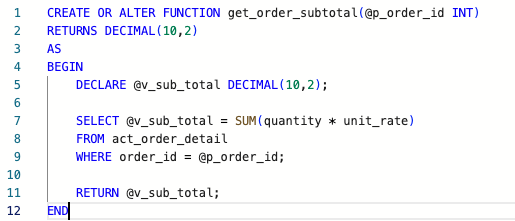
CREATE OR ALTER FUNCTION get_order_subtotal(@p_order_id INT)
RETURNS DECIMAL(10,2)
AS
BEGIN
   DECLARE @v_sub_total DECIMAL(10,2);
   SELECT @v_sub_total = SUM(quantity * unit_rate)
   FROM act_order_detail
   WHERE order_id = @p_order_id;
   RETURN @v_sub_total;
END
Comments Not Found