
Microsoft SQL Server
EXISTS, ANY and ALL Clause
In Microsoft SQL Server, the EXISTS, ANY, and ALL operators are used in subqueries to perform conditional checks based on the results of another query. These operators allow you to perform more complex filtering by evaluating whether certain conditions are met in related tables or subqueries. For beginners, understanding these operators is essential for writing more advanced queries that depend on relationships between different sets of data.
Below is a detailed explanation of how to use EXISTS, ANY, and ALL, along with examples and best practices.
1. EXISTS Operator
The EXISTS operator is used to check whether a subquery returns any rows. If the subquery returns at least one row, the EXISTS condition evaluates to TRUE. This is often used in correlated subqueries to filter rows based on the presence of related data.
SELECT column_name
FROM table_name
WHERE EXISTS (subquery);
Example:
SELECT ProductName
FROM Products p
WHERE EXISTS (
    SELECT *
    FROM Sales s
    WHERE s.ProductID = p.ProductID
);
This query retrieves all products that have at least one sale in the Sales table.
2. ANY Operator
The ANY operator compares a value to any value in a list or subquery. It returns TRUE if the comparison is TRUE for at least one of the values. It is typically used with comparison operators like =, >, <, etc.
SELECT column_name
FROM table_name
WHERE column_name operator ANY (subquery);
Example:
SELECT ProductName, Price
FROM Products
WHERE Price > ANY (
    SELECT Price
    FROM Products
    WHERE Category = 'Electronics'
);
This query retrieves all products whose price is greater than the price of at least one product in the Electronics category.
3. ALL Operator
The ALL operator compares a value to all values in a list or subquery. It returns TRUE if the condition is TRUE for all the values in the subquery. Like ANY, it is used with comparison operators.
SELECT column_name
FROM table_name
WHERE column_name operator ALL (subquery);
Example:
SELECT ProductName, Price
FROM Products
WHERE Price > ALL (
    SELECT Price
    FROM Products
    WHERE Category = 'Clothing'
);
This query retrieves all products whose price is greater than the price of all products in the Clothing category.
4. Best Practices for Using EXISTS, ANY, and ALL
Use
EXISTSfor Efficient Checking – When checking whether related data exists, theEXISTSoperator is generally more efficient thanJOIN, especially when you don’t need to return the related data itself, just the existence of it.SELECT * FROM Customers c WHERE EXISTS ( SELECT * FROM Sales s WHERE s.CustomerID = c.CustomerID );Use
ANYfor Comparison to At Least One Value – TheANYoperator is ideal when you want to check if a value is greater than, less than, or equal to at least one value returned by the subquery.SELECT * FROM Products WHERE Price < ANY ( SELECT Price FROM Products WHERE Category = 'Furniture' );Use
ALLfor Strict Comparison – TheALLoperator is useful when you want to compare a value to all the values returned by a subquery. It’s typically used when you need to ensure that a condition holds for all the values in the subquery.SELECT * FROM Products WHERE Price > ALL ( SELECT Price FROM Products WHERE Category = 'Groceries' );Optimize Performance with Indexed Columns – When using
EXISTS,ANY, orALLin subqueries, ensure that the columns involved in the subquery are indexed. This can significantly improve query performance.Test Subqueries for Accuracy – Always test the results of your subqueries individually to ensure that they return the expected results. Complex subqueries can sometimes produce unexpected outcomes.
By mastering the EXISTS, ANY, and ALL operators, you will be able to write more powerful and flexible SQL queries that take into account complex relationships between tables in your SQL Server databases.
To gain complete access, login with gmail or outlook, no need of signup, click here

Test code
In Microsoft SQL Server, to select all customers who have placed an order, you can use the EXISTS operator with the following query:
SELECT *
FROM org_client
WHERE EXISTS (SELECT 1 FROM act_order WHERE org_client.client_id = act_order.client_id);In Microsoft SQL Server, to identify married couples whose credit limit surpasses the credit limit of every bachelor, you can use the ALL operator with the following query:
SELECT *
FROM org_client
WHERE credit_limit > ALL (SELECT credit_limit FROM org_client WHERE married_flag = 0)
AND married_flag = 1;In Microsoft SQL Server, to identify single female clients born in the same year as any single male clients, you can use the ANY operator with the following query:
SELECT *
FROM org_client
WHERE birth_year = ANY (SELECT birth_year FROM org_client WHERE gender = 'M' AND married_flag = 0)
AND gender = 'F'
AND married_flag = 0;SQL EXISTS Clause
SELECT * FROM org_client WHERE EXISTS (SELECT 1 FROM act_order WHERE org_client.client_id = act_order.client_id);SQL EXISTS Clause - data mapping
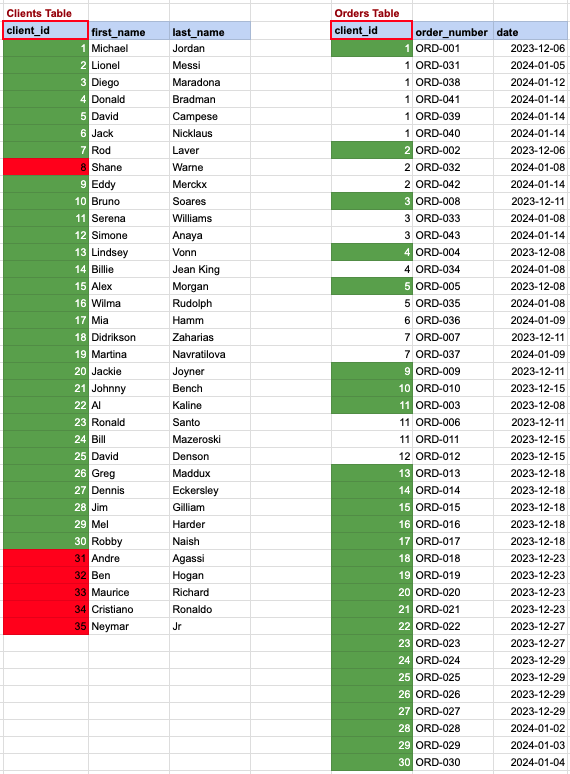
In this scenario, we aim to list clients who have made at least one order. Referring to the image, the clients from the 'clients' table, highlighted with a green background, meet our criteria, as they have placed one or more orders in the 'orders' table on the right. Conversely, clients marked with a red background are those who haven't placed any orders in the table on the right.
SQL ALL Clause
SELECT * FROM org_client WHERE credit_limit > ALL (SELECT credit_limit FROM org_client WHERE married_flag = 0) AND married_flag = 1;SQL ALL Clause data mapping
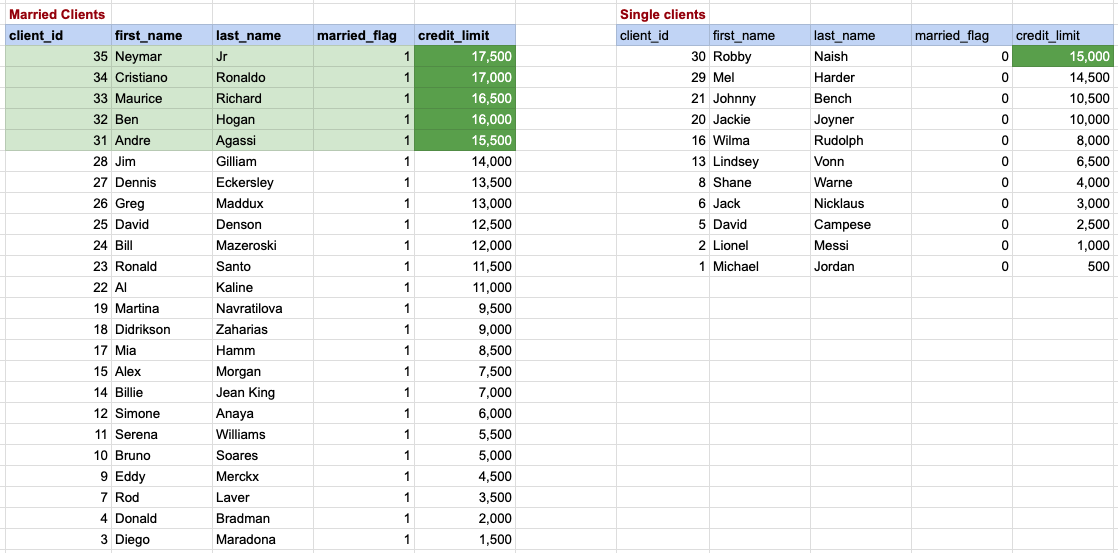
In this context, we are focused on identifying married couples whose credit limit is higher than the highest credit limit among bachelors. The bachelors and their respective credit limits are displayed on the right side, arranged in descending order with the top credit limit being 15,000. Therefore, for married clients to have a higher credit rating than all bachelors, they must exceed this top credit limit. Rows with a green background on the left represent the data of married couples that fulfill our criteria.
SQL ANY Clause
SELECT * FROM org_client WHERE birth_year = ANY (SELECT birth_year FROM org_client WHERE gender = 'M' AND married_flag = 0) AND gender = 'F' AND married_flag = 0;SQL ANY Clause data mapping

In this case, our goal is to find single female clients who share the same birth year as any of the single male clients. The data for single females, along with their birth years, is displayed on the left, while the information for single males is listed on the right. Single female clients whose data is highlighted with a green background are those whose birth year matches with that of a single male from the right side.
Comments Not Found