
Microsoft SQL Server
Chapter 7 - DQL (Data Query Language)
DQL ASSIGNMENT3 - MS SQL Logic for Dashboard Reporting in a Store Management System
SQL Assignment:
As part of this SQL assignment, you are required to design SQL queries that will extract the necessary data from a relational database to generate insights for a Store Management System Dashboard. The dashboard will focus on key areas such as products, customers, orders, inventory, and employee performance.
1. Product Overview
- Task: Write SQL queries to generate the following metrics:
- Total Products in Stock: Write a query to count the total number of products currently available across all stores.
- Products by Category: Write a query to count the number of products for each category (for a bar or pie chart).
- Low Stock Products: Write a query to list products that have a stock quantity below a certain threshold (e.g., less than 10 units).
- Recently Added Products: Write a query to list products added in the last 30 days.
2. Customer Overview
- Task: Write SQL queries to pull customer-related insights:
- Total Number of Customers: Write a query to count the total number of customers in the system.
- Active Customers: Write a query to retrieve customers who have placed orders in the last 6 months.
- Customer Purchase History: Write a query that retrieves all orders made by each customer, showing total amounts and order dates (for a table).
- Customer Registration: Write a query to list all customers who registered in the last month.
3. Order Overview
- Task: Use SQL to pull order-related insights:
- Total Orders by Month: Write a query that retrieves the number of orders placed each month.
- High-Value Orders: Write a query that lists all orders above a certain total amount (e.g., greater than 500 USD).
- Orders by Product: Write a query that retrieves the total quantity ordered for each product (for a bar chart).
- Pending Orders: Write a query that lists all orders that have not been fulfilled yet.
4. Employee Overview
- Task: Write SQL queries to manage employee-related data:
- Number of Employees per Store: Write a query to retrieve the number of employees working at each store.
- Employee Salary Report: Write a query to retrieve the salary details for all employees.
5. Inventory Overview
- Task: Write SQL queries to pull inventory data across stores:
- Inventory by Store: Write a query that retrieves the total quantity of products available at each store.
- Out-of-Stock Products: Write a query to list products that are out of stock at any store.
- Inventory by Supplier: Write a query that lists the quantity of products supplied by each supplier to all stores.
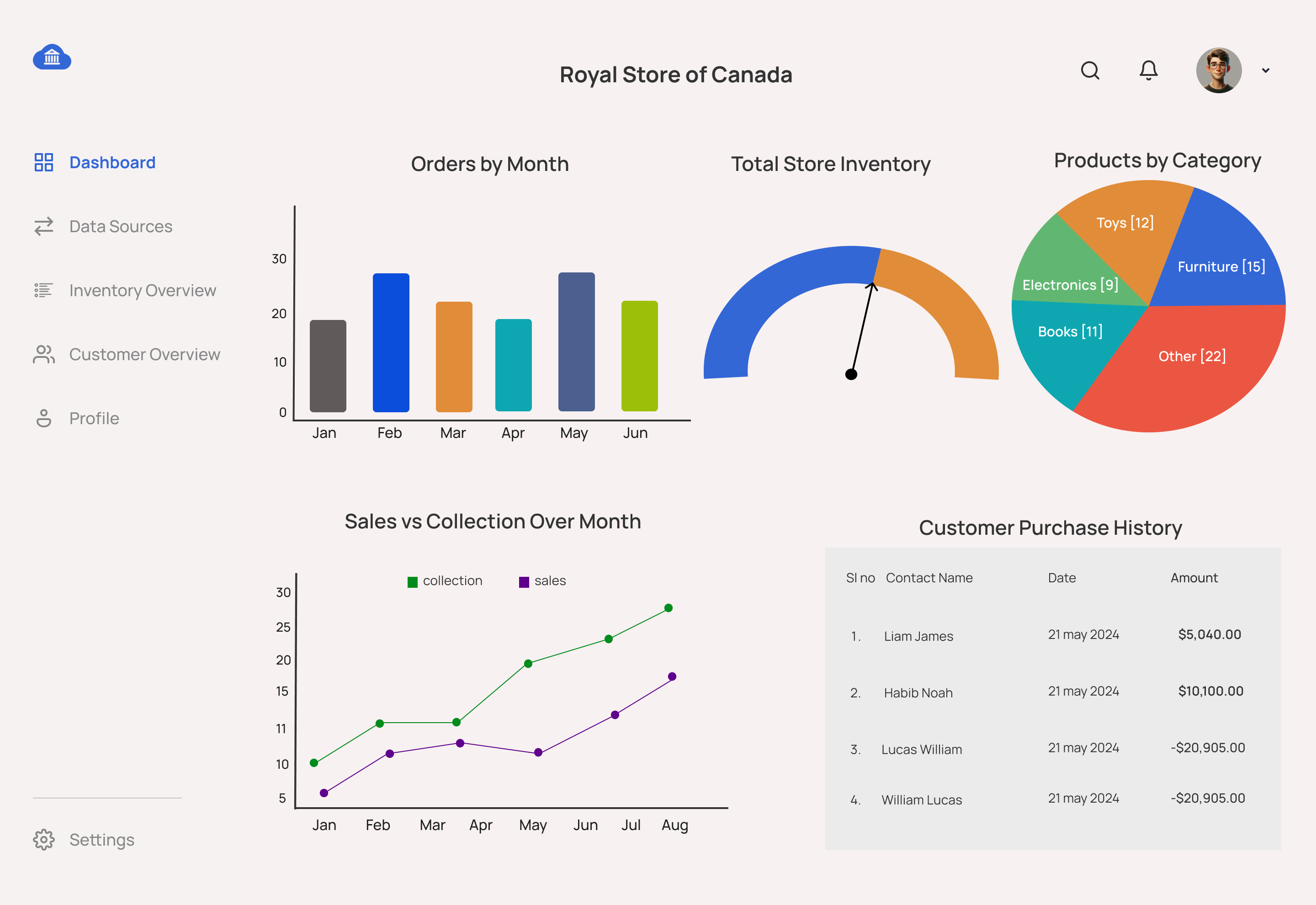
Key Visuals and Corresponding SQL Queries:
Note: All dashboard queries must work against current month or current year filters
Pie Chart - Products by Category
- Query: Write an SQL query to retrieve the number of products for each category from the `PRODUCT` table.
- Sections: Product categories with the number of products as values.
Bar Chart - Orders by Month
- Query: Write a query that retrieves the number of orders placed in each month from the `ORDER` table, grouped by order date (by month).
- X-Axis: Order date (by month).
- Y-Axis: Number of orders.
Multi Line Graph - Sales vs Collection Over Month
- Query: Write a query to compare total sales amounts (from the `ORDER` table) and collections (from the `PAYMENT` table) for each month.
- X-Axis: Month (grouped by order_date and payment_date).
- Y-Axis: Total sales and collection amounts. Two lines in the graph, one for sales and other for collections.
- Details: Sales data comes from the `total_amount` field in the `ORDER` table, while collection data comes from the `amount_paid` field in the `PAYMENT` table.
Table - Customer Purchase History
- Query: Write an SQL query to retrieve order details from the `ORDER` and `CUSTOMER` tables, showing customer names, order dates, and total amounts.
- Columns: Customer Name, Order Date, Total Amount.
Gauge - Total Store Inventory
- Query: Write an SQL query to calculate the total quantity of products in stock across all stores from the `INVENTORY` table.
- Display: Total quantity of products available.
GOOD LUCK WITH YOUR ASSIGNMENT!!!
Don't forget to contact us if you need any further assistance with your assignments, and most importantly, for a manual review and approval of your work.
Sample ERD and Data Model for Dashboard Reporting Logic in a Store Management System
Comments Not Found