
Microsoft SQL Server
Third Normal Form
Third Normal Form (3NF) is a step in the database normalization process that builds upon Second Normal Form (2NF). A table is in 3NF if it is already in 2NF and all the non-key columns are not only fully dependent on the primary key but also independent of each other. In simpler terms, 3NF ensures that no non-key column is dependent on another non-key column. This prevents transitive dependencies, which occur when one non-key column depends on another non-key column instead of the primary key.
Key Concepts of Third Normal Form (3NF):
Remove Transitive Dependencies
- In 3NF, there should be no transitive dependencies, where a non-key column is dependent on another non-key column.
- If a column can be derived from another non-key column, it should be placed in a separate table.
Example SQL (violating 3NF):
CREATE TABLE Customers (
    CustomerID INT PRIMARY KEY,
    CustomerName VARCHAR(100),
    ContactNumber VARCHAR(15),
    StoreLocation VARCHAR(100),  -- StoreLocation depends on StoreID, not CustomerID
    StoreID INT
);
Move Dependent Columns to Separate Tables
- To remove the transitive dependency, move the dependent column to another table. For example,
StoreLocationshould be in aStorestable rather than theCustomerstable.
Example SQL (corrected to 3NF):
CREATE TABLE Customers ( CustomerID INT PRIMARY KEY, CustomerName VARCHAR(100), ContactNumber VARCHAR(15), StoreID INT ); CREATE TABLE Stores ( StoreID INT PRIMARY KEY, StoreLocation VARCHAR(100) );- To remove the transitive dependency, move the dependent column to another table. For example,
Ensure Full Dependency on the Primary Key
- All non-key attributes in the table should depend only on the primary key. If any non-key attribute is dependent on another non-key attribute, it needs to be moved to a new table.
Example SQL (adding foreign key to maintain relationship):
CREATE TABLE Customers (
    CustomerID INT PRIMARY KEY,
    CustomerName VARCHAR(100),
    ContactNumber VARCHAR(15),
    StoreID INT,
    FOREIGN KEY (StoreID) REFERENCES Stores(StoreID)
);
Normalization through Decomposition
- In 3NF, you decompose your tables to remove transitive dependencies while maintaining relationships between the tables.
- For instance, moving
StoreLocationfrom theCustomerstable to aStorestable ensures thatStoreLocationdepends directly onStoreID, notCustomerID.
Example SQL (decomposed tables):
CREATE TABLE Products (
    ProductID INT PRIMARY KEY,
    ProductName VARCHAR(100),
    StoreID INT,
    FOREIGN KEY (StoreID) REFERENCES Stores(StoreID)
);
Example of Transitive Dependency
- Let’s say
ProductPricedepends onProductID, andProductDiscountdepends onProductPrice. This is a transitive dependency, and we should moveProductDiscountto another table to remove it from the original table.
Example SQL (removing transitive dependency):
CREATE TABLE ProductPrices ( ProductID INT PRIMARY KEY, ProductPrice DECIMAL(10, 2) ); CREATE TABLE ProductDiscounts ( ProductID INT PRIMARY KEY, Discount DECIMAL(5, 2), FOREIGN KEY (ProductID) REFERENCES ProductPrices(ProductID) );- Let’s say
By achieving Third Normal Form (3NF), you eliminate transitive dependencies, ensuring that every non-key column depends solely on the primary key. This improves the structure of the database, reduces redundancy, and makes maintenance easier.
Third Normal Form (3NF)
Third Normal Form (3NF) is a crucial concept in database normalization that ensures data is structured in a way that reduces redundancy and avoids undesirable dependencies. To be in 3NF, a database table must first satisfy the requirements of the Second Normal Form (2NF), and then go a step further to eliminate transitive dependencies among non-key attributes. Let's dive into the details of 3NF with a clear example.
Understanding 3NF
For a table to be in 3NF:
- It must already be in 2NF. This means that the table is in 1NF (all attributes contain only atomic values and the table contains no repeating groups), and all non-key attributes are fully functionally dependent on the primary key (i.e., no partial dependencies for composite primary keys).
- It must have no transitive dependencies. A transitive dependency occurs when a non-key attribute depends on another non-key attribute. To meet the 3NF requirements, every non-key attribute must directly depend on the primary key.
Why 3NF?
3NF is designed to improve database efficiency and integrity by:
- Reducing redundancy:Ensuring that all information is stored only once, which makes the database easier to maintain.
- Preventing update anomalies:Eliminating transitive dependencies helps prevent inconsistencies that can arise when data is updated in one place but not another.
Suppose we have a table calledEmployee_Departmentwith the following attributes:
- Employee_ID (Primary Key)
- Employee_Name
- Department_ID
- Department_Name
- Manager_ID
To achieve 3NF, we would decompose this table into two separate tables:
Table 1:Employee_Details:
- Employee_ID (Primary Key)
- Employee_Name
- Department_ID (Foreign Key)
Table 2:Department_Details:
- Department_ID (Primary Key)
- Department_Name
- Manager_ID (Foreign Key)
By doing this, we eliminate the transitive dependency betweenDepartment_NameandManager_ID, ensuring that each table represents a single entity and all attributes are functionally dependent on the primary key.
THIRD NORMAL FORM EXAMPLE
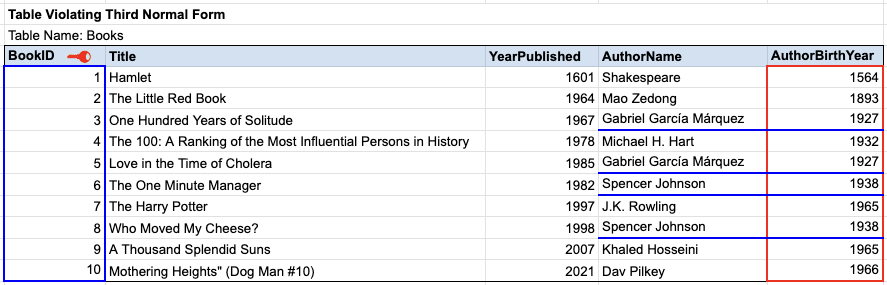
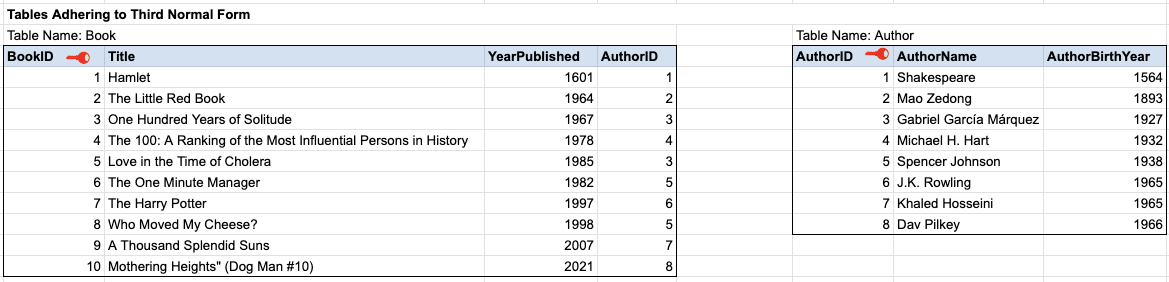
- 3NF Violation: The original books inventory table violates Third Normal Form (3NF) due to a transitive dependency.
- Transitive Dependency: The
author birth yearattribute does not depend functionally on the primary key (book id), but rather on another non-primary key attribute (author). - Solution for 3NF Compliance: To resolve this issue, transfer the
author nameandauthor birth yearfrom the books table to a separate dedicatedAuthorstable.
Comments Not Found