
MySQL
Database Index
A database index is a data structure that improves the speed of data retrieval operations on a database table at the cost of additional space and maintenance overhead. Indexes work similarly to indexes in books: they allow the database management system to quickly locate and access data without scanning the entire table. By creating an index on one or more columns, you can significantly enhance query performance, especially on large tables.
Here’s a closer look at how database indexes work:
Types of Indexes
- Primary Index: Automatically created when you define a primary key. Ensures uniqueness and improves performance on queries involving the primary key.
- Unique Index: Ensures that all values in a column or a set of columns are unique.
- Composite Index: An index on multiple columns. Useful for queries that filter or sort based on more than one column.
- Full-Text Index: Used for full-text search queries, allowing you to search for words or phrases in text columns.
-- Creating a Primary Index
CREATE TABLE Employees (
    EmployeeID INT PRIMARY KEY, -- Primary Index
    EmployeeName VARCHAR(50),
    DepartmentID INT,
    FOREIGN KEY (DepartmentID) REFERENCES Departments(DepartmentID)
);
-- Creating a Unique Index CREATE TABLE Employees ( EmployeeID INT PRIMARY KEY, EmailAddress VARCHAR(100) UNIQUE, -- Unique Index EmployeeName VARCHAR(50), DepartmentID INT, FOREIGN KEY (DepartmentID) REFERENCES Departments(DepartmentID) );Creating an Index
- You can create an index on one or more columns to speed up queries that filter or sort based on those columns.
-- Creating a Composite Index CREATE INDEX idx_department_name ON Employees (DepartmentID, EmployeeName); -- Composite Index- This index helps speed up queries that search by
DepartmentIDandEmployeeName.
Benefits of Indexes
- Improved Query Performance: Indexes can dramatically speed up the retrieval of rows from a table, especially for large datasets.
- Faster Sorting and Filtering: Indexes help speed up operations involving sorting and filtering on indexed columns.
- Efficient Data Access: Reduces the need to scan the entire table for queries.
-- Example of a query benefiting from an index SELECT EmployeeName FROM Employees WHERE DepartmentID = 3 ORDER BY EmployeeName;- In this example, if there is an index on
DepartmentID, the query will execute more efficiently.
Drawbacks of Indexes
- Additional Storage: Indexes require additional disk space to store the index data.
- Maintenance Overhead: Indexes need to be updated whenever data is inserted, updated, or deleted, which can impact performance on write operations.
Viewing and Managing Indexes
- You can view existing indexes on a table and manage them using SQL commands.
-- Viewing existing indexes
SHOW INDEX FROM Employees;
-- Dropping an index DROP INDEX idx_department_name ON Employees;- Use these commands to view and manage indexes based on your performance needs.
Best Practices for Indexes
- Index Columns Used in WHERE Clauses: Create indexes on columns that are frequently used in WHERE clauses to speed up search operations.
- Consider Index Size and Maintenance: Balance the benefits of indexing with the added storage and maintenance costs.
- Regularly Review Indexes: Periodically review and optimize indexes based on changing query patterns and data distribution.
Indexes are crucial for optimizing database performance, especially as the size and complexity of your data grow. By understanding how and when to use indexes, you can significantly enhance the efficiency of your database queries and overall system performance.
To gain complete access, login with gmail or outlook, no need of signup, click here
Simple English Explanation of Database Index
Think of a database like a big library, and each piece of information in the database is like a book in the library. Now, if you wanted to find a book on dinosaurs in this huge library, it would take a long time to look through every single book. That's where an index comes in handy.
A database index works like the index at the back of a book or the catalog in a library. It's a special list that the database uses to find information quickly. Instead of looking through every "book" (or piece of information) in the "library" (database), the database looks at the index to see exactly where the information you asked for is located. This way, it can go straight to it without wasting time searching through everything.
So, just like you'd use a library catalog to find your book on dinosaurs fast, a database uses an index to find the information you need quickly. It makes searching for data much faster, especially when there's a lot of it.
Analogy: The Recipe Box
Imagine you have a large box filled with hundreds of recipes. Each recipe is written on a separate card. If you want to find a recipe for "chocolate cake," you would have to go through each card one by one until you find it. This process is slow and mirrors how a database works without any indexes—scanning each row (or "card") to find the information you need.
Now, suppose you decide to organize these recipe cards to make finding recipes faster. You create several dividers, each labeled with a category: desserts, main dishes, appetizers, etc. Inside the "desserts" section, you further organize the recipes alphabetically. Now, when you want to find that chocolate cake recipe, you go directly to the "desserts" section and quickly find the card among the neatly ordered dessert recipes. This method of organizing recipes is akin to using an index in a database.
The Index in Action
- Before Indexing:You sift through every recipe card for "chocolate cake," which takes a lot of time.
- After Indexing:You go straight to the "desserts" divider and easily find "chocolate cake" among the alphabetically sorted recipes.
Real-World Example: The Grocery Store
Consider how grocery stores are organized. Each aisle has a sign indicating what products can be found there (e.g., dairy, fruits, cereals). When you enter the store looking for milk, you don't wander every aisle; you head straight to the dairy section.
In this scenario:
- The grocery store is the database.
- Each aisle is a table within the database.
- The signs indicating product categories are the indexes.
- The products are the rows of data.
Just as the signs (indexes) in the grocery store help you find products faster by directing you to the right aisle, a database index allows quick data retrieval by eliminating the need to scan every row in a table.
Benefits in Everyday Terms
- Saves Time:Just as organizing recipes or using grocery aisle signs saves you time, indexing saves time when retrieving data from a database.
- Improves Efficiency:You can find what you're looking for much faster, whether it's a recipe in a box or an item in a store, just as an index improves a database's efficiency in handling queries.
This analogy simplifies the concept of database indexing, showing how organizing information helps in quickly finding what we need, a principle that's beneficial both in everyday life and in the technical realm of databases.
Implementing Indexing
To improve search performance, the website's database administrator decides to create indexes on the Category and Price columns of the Products table.
SQL Example for Creating Indexes
Assume a Products table structure:
CREATE TABLE Products (
    ProductID INT PRIMARY KEY,
    ProductName VARCHAR(255),
    Category VARCHAR(50),
    Price DECIMAL(10,2),
    StockStatus VARCHAR(10)
);

-- Creating an index on the 'Category' column
CREATE INDEX idx_category ON Products (Category);

-- Creating an index on the 'Price' column
CREATE INDEX idx_price ON Products (Price);
Impact of Indexing
With these indexes in place, when a customer searches for all products in the "Electronics" category or looks for items under $100, the DBMS utilizes theidx_categoryandidx_priceindexes to quickly locate and retrieve relevant product records. The search operation becomes significantly faster, improving the website's responsiveness and user satisfaction.
Real-World Benefits
- Enhanced Search Performance:Product searches that previously took seconds now return results almost instantaneously.
- Scalability:As the product catalog grows, the indexes help maintain quick search response times, ensuring the website can handle increased traffic and data volume.
- Improved User Experience:Customers enjoy a smoother browsing experience with minimal waiting times, encouraging them to explore more products and potentially increasing sales.
Considerations
- Storage Overhead:Indexes consume additional disk space.
- Maintenance Cost:Inserting, updating, or deleting product records requires the indexes to be updated, which can slightly slow down these operations. However, for a read-heavy application like an e-commerce website, the benefits of faster searches typically outweigh these costs.
Conclusion
In this real-world example, database indexing transforms the e-commerce website's product search functionality from slow and cumbersome to fast and efficient. By carefully selecting which columns to index based on common search patterns, the website can offer a vastly improved shopping experience, demonstrating the critical role of indexing in database and application performance optimization.
DATABASE INDEX USAGE
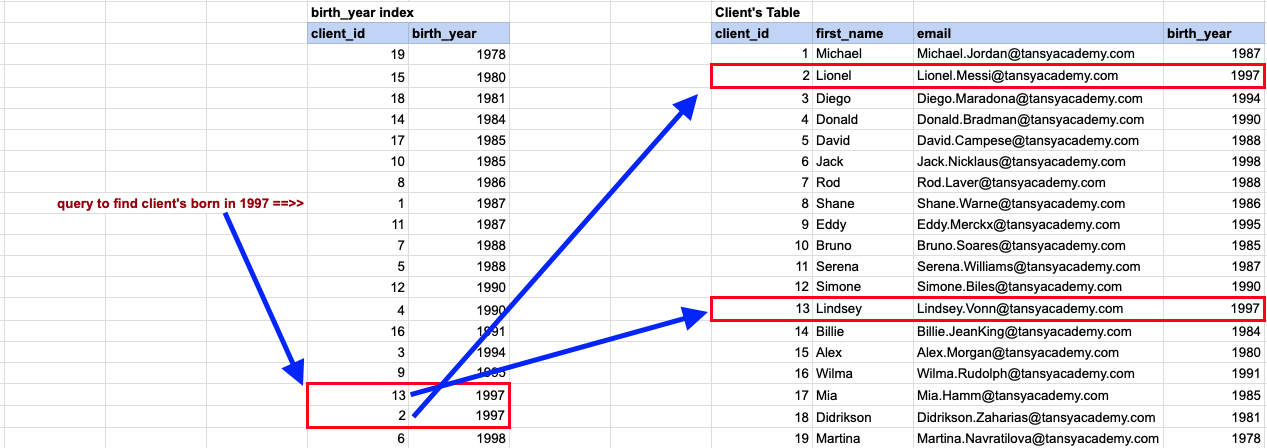
- Query Submission: A database user submits a query to retrieve a list of clients born in
1997. - Step 1 (Index Lookup): The query accesses the index directly to locate entries matching
1997. Because the index is pre-sorted, it completely avoids scanning through all index rows. - Step 2 (Primary Key Pointer): The index contains direct references (pointers) to the table's primary keys.
- Step 3 (Targeted Row Retrieval): The database directly fetches only the matching rows using the primary key references without needing to examine all rows in the original clients table.
Comments Not Found