
MySQL
NOT LIKE Operator
In MySQL, the NOT LIKE operator is used to filter rows where a column's value does not match a specified pattern. It works as the opposite of the LIKE operator and allows you to exclude records based on patterns within string data. This operator is particularly useful when you need to find rows that do not conform to specific text formats or exclude certain patterns from your result set.
Here’s how to use the NOT LIKE operator in MySQL, along with examples and helpful tips for new students:
Basic Syntax of
NOT LIKE:- The
NOT LIKEoperator is used in theWHEREclause to exclude rows where the column value matches a specified pattern. - Syntax:
SELECT * FROM employees WHERE first_name NOT LIKE 'A%';- This query returns all employees whose first names do not start with the letter "A". The
%wildcard represents any sequence of characters.
- The
Using
%Wildcard withNOT LIKE:- The
%wildcard can be used withNOT LIKEto exclude rows based on patterns with any number of characters. - Example:
SELECT * FROM employees WHERE last_name NOT LIKE '%son';- This query returns all employees whose last names do not end with "son", excluding names like "Johnson" or "Wilson".
- The
Using
_Wildcard withNOT LIKE:- The
_wildcard matches exactly one character, and withNOT LIKE, it helps exclude records where there are specific single-character patterns. - Example:
SELECT * FROM employees WHERE department_name NOT LIKE 'R_n%';- This query excludes departments where the name starts with "R", followed by any single character, and then "n". For example, it would exclude departments like "Runway" or "Rentals".
- The
Combining
NOT LIKEwith Other Conditions:- You can combine
NOT LIKEwithANDorORto build more complex queries that filter based on multiple conditions. - Example:
SELECT * FROM employees WHERE first_name NOT LIKE 'J%' AND department_id = 2;- This query returns employees who do not have first names starting with "J" and who work in department 2.
- You can combine
Case Sensitivity in
NOT LIKE:- By default,
NOT LIKEis case-insensitive in MySQL, which means that it will match patterns regardless of case. If you need case-sensitive comparisons, use theBINARYkeyword. - Example:
SELECT * FROM employees WHERE BINARY first_name NOT LIKE 'john%';- This query excludes rows where the first name starts with "john", case-sensitive, so names like "John" or "JOHN" are not excluded.
- By default,
Using
NOT LIKEin Joins:- The
NOT LIKEoperator can be used in queries involving joins to exclude rows based on patterns in related tables. - Example:
SELECT e.first_name, d.department_name FROM employees e JOIN departments d ON e.department_id = d.department_id WHERE d.department_name NOT LIKE 'Marketing%';- This query returns employees who do not work in departments whose names start with "Marketing".
- The
Performance Considerations:
- Using
NOT LIKEwith wildcards, especially at the beginning of the pattern (%something), can impact query performance on large datasets. Indexing the relevant columns may help optimize performance. - Example:
SELECT * FROM employees WHERE email NOT LIKE '%@company.com';- This query retrieves employees whose email addresses do not end with "@company.com". However, this type of query can be slow if the column is not indexed.
- Using
The NOT LIKE operator is a valuable tool when you need to exclude rows based on string patterns in MySQL. By combining it with wildcards and other conditions, you can filter out data that matches specific patterns, giving you more control over your queries and results.
To gain complete access, login with gmail or outlook, no need of signup, click here

Test code
Fetch records for clients whose last names do not start with 'M%', where '%' indicates the potential presence of zero or more characters following 'M'.
SELECT *
FROM org_client
WHERE last_name NOT LIKE 'M%';Retrieve entries for clients whose first names do not conclude with '%e'.
SELECT *
FROM org_client
WHERE first_name NOT LIKE '%e';Example 1:
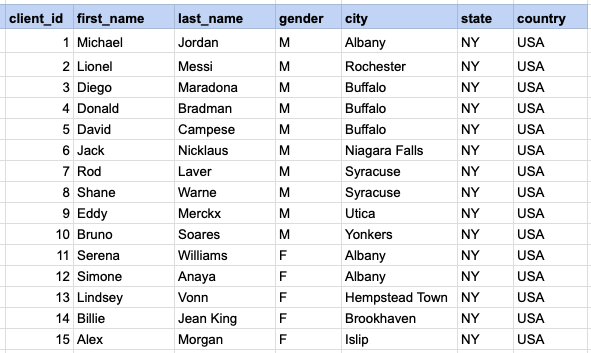
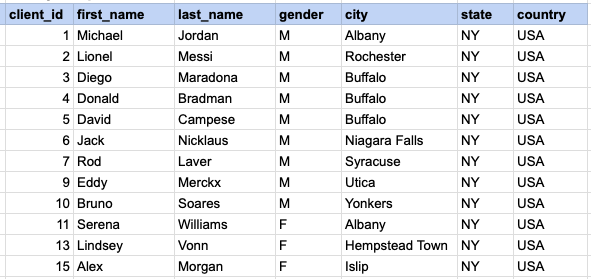
Explore the procedure of retrieving data from a designated table using the SQL NOT LIKE operator. Fetch records for clients whose last names do not start with 'M%', where '%' indicates the potential presence of zero or more characters following 'M'.
Example 1 - Raw data from client table
Example 1 - Query
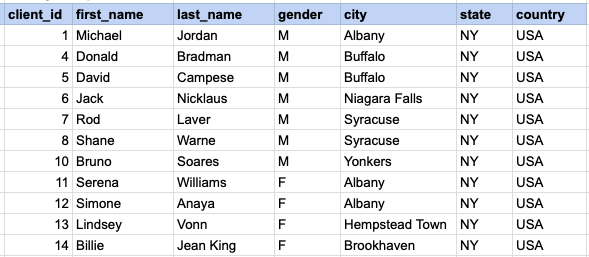
SELECT * FROM org_client WHERE last_name NOT LIKE 'M%';Example 1 - Query data mapping
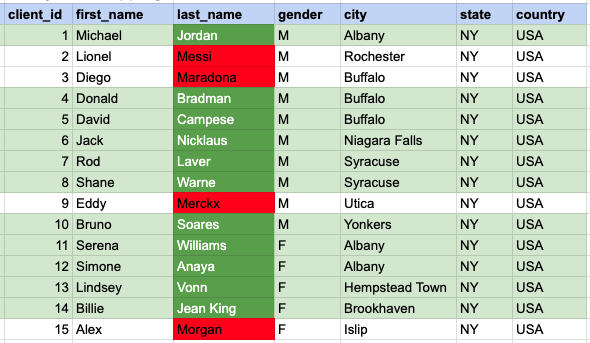
In the provided image, the green color signifies the data that has been selected or satisfies the conditions specified in our query. Data points in red indicate information that does not meet the criteria set by the query.
Example 1 - Query Output
Example 2:
Retrieve entries for clients whose first names do not conclude with '%e'.
Example 2 - Query
SELECT * FROM org_client WHERE first_name NOT LIKE '%e';Example 2 - Query data mapping
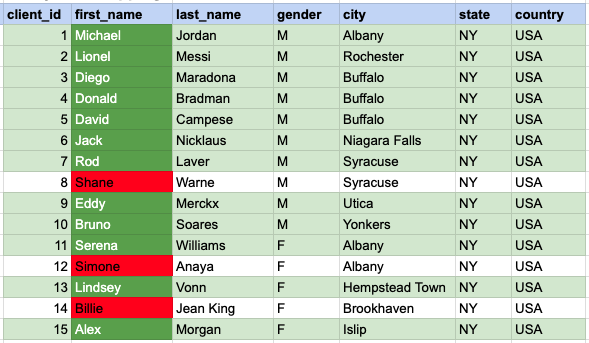
In the provided image, the green color signifies the data that has been selected or satisfies the conditions specified in our query. Data points in red indicate information that does not meet the criteria set by the query.
Example 2 - Query Output
Comments Not Found