
MySQL
EXISTS, ANY and ALL Clause
In MySQL, the EXISTS, ANY, and ALL operators are powerful tools for handling subqueries in the Data Query Language (DQL). These operators allow you to perform more complex queries by interacting with other queries, enabling you to check the existence of rows, compare values against a set of results, or apply conditions to every element in a list. They are essential when working with relationships between tables or filtering data based on the results of subqueries.
Here’s an overview of how to use EXISTS, ANY, and ALL in MySQL with examples:
1. Using EXISTS:
- The
EXISTSoperator checks whether a subquery returns any rows. It returnsTRUEif the subquery finds at least one matching row andFALSEotherwise.EXISTSis often used to test the presence of related records. - Syntax:
SELECT *
FROM employees e
WHERE EXISTS (SELECT 1
              FROM departments d
              WHERE d.department_id = e.department_id
              AND d.department_name = 'Marketing');
- This query returns all employees who belong to the "Marketing" department. The subquery checks if a matching department exists.
Additional Points:
EXISTSstops searching as soon as it finds a matching row, making it efficient for presence checks.- It’s commonly used with correlated subqueries where the inner query references the outer query.
2. Using ANY:
- The
ANYoperator compares a value to any value in a set of results. It returnsTRUEif the condition is satisfied by at least one value from the subquery. It’s useful when you want to match a value against multiple possibilities. - Syntax:
SELECT *
FROM employees
WHERE salary > ANY (SELECT salary
                    FROM employees
                    WHERE department_id = 2);
- This query returns employees whose salary is greater than any salary in department 2 (i.e., higher than the lowest salary in that department).
Additional Points:
- The
ANYoperator can be combined with comparison operators such as>,<,=. - If the subquery returns no rows,
ANYreturnsFALSE.
3. Using ALL:
- The
ALLoperator compares a value against all values returned by a subquery. It returnsTRUEonly if the condition is true for all values in the subquery result. - Syntax:
SELECT *
FROM employees
WHERE salary > ALL (SELECT salary
                    FROM employees
                    WHERE department_id = 3);
- This query returns employees whose salary is higher than the highest salary in department 3.
Additional Points:
- Like
ANY, theALLoperator works with comparison operators (>,<,=). - If the subquery returns no rows,
ALLreturnsTRUEbecause no value contradicts the condition.
4. Combining EXISTS, ANY, and ALL with Joins:
- You can combine these operators with joins to filter results based on related tables.
- Example:
SELECT e.first_name, d.department_name
FROM employees e
JOIN departments d
ON e.department_id = d.department_id
WHERE EXISTS (SELECT 1
              FROM employees
              WHERE manager_id = e.employee_id);
- This query returns employees who manage other employees (i.e., they are referenced as a
manager_idin theemployeestable).
5. Performance Considerations:
- Subqueries involving
EXISTS,ANY, andALLcan be resource-intensive, especially when working with large datasets. To optimize performance, ensure that the columns involved in subqueries are indexed. - Example:
SELECT *
FROM employees
WHERE EXISTS (SELECT 1
              FROM departments
              WHERE departments.department_id = employees.department_id
              AND departments.branch_id = 2);
- This query checks for the existence of employees in branch 2, but indexing
department_idandbranch_idcan help improve performance.
These examples show how EXISTS, ANY, and ALL can be effectively used in subqueries to filter data based on complex conditions. Understanding these operators allows you to query data more flexibly and efficiently when working with related tables.
To gain complete access, login with gmail or outlook, no need of signup, click here

Test code
Select all customers who have placed an order.
SELECT * FROM org_client
WHERE EXISTS (SELECT 1 FROM act_order WHERE org_client.client_id = act_order.client_id);Identify married couples whose credit limit surpasses the credit limit of every bachelor.
SELECT * FROM org_client
WHERE credit_limit > ALL (SELECT credit_limit FROM org_client WHERE married_flag = 0)
AND married_flag = 1;Identify single female clients born in the same year as any single male clients.
SELECT * FROM org_client
WHERE birth_year = ANY (SELECT birth_year FROM org_client WHERE gender = 'M' AND married_flag = 0)
AND gender = 'F'
AND married_flag = 0;SQL EXISTS Clause
SELECT * FROM org_client WHERE EXISTS (SELECT 1 FROM act_order WHERE org_client.client_id = act_order.client_id);SQL EXISTS Clause - data mapping
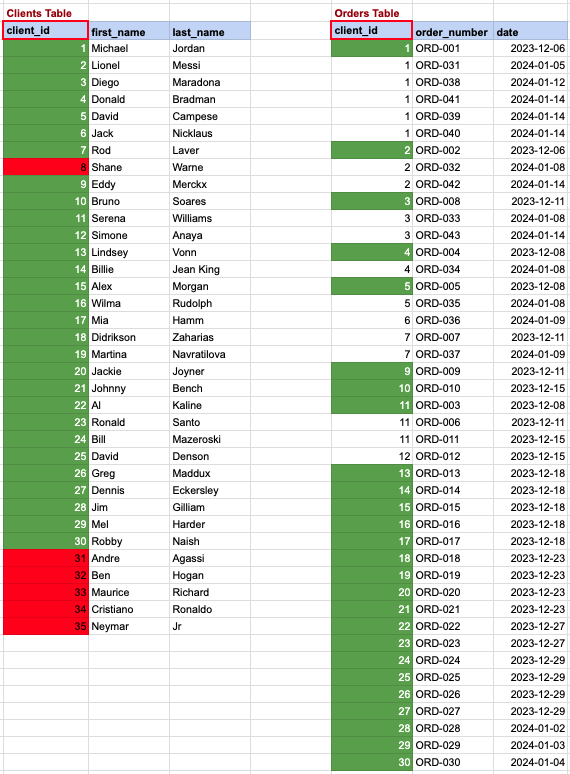
In this scenario, we aim to list clients who have made at least one order. Referring to the image, the clients from the 'clients' table, highlighted with a green background, meet our criteria, as they have placed one or more orders in the 'orders' table on the right. Conversely, clients marked with a red background are those who haven't placed any orders in the table on the right.
SQL ALL Clause
SELECT * FROM org_client WHERE credit_limit > ALL (SELECT credit_limit FROM org_client WHERE married_flag = 0) AND married_flag = 1;SQL ALL Clause data mapping
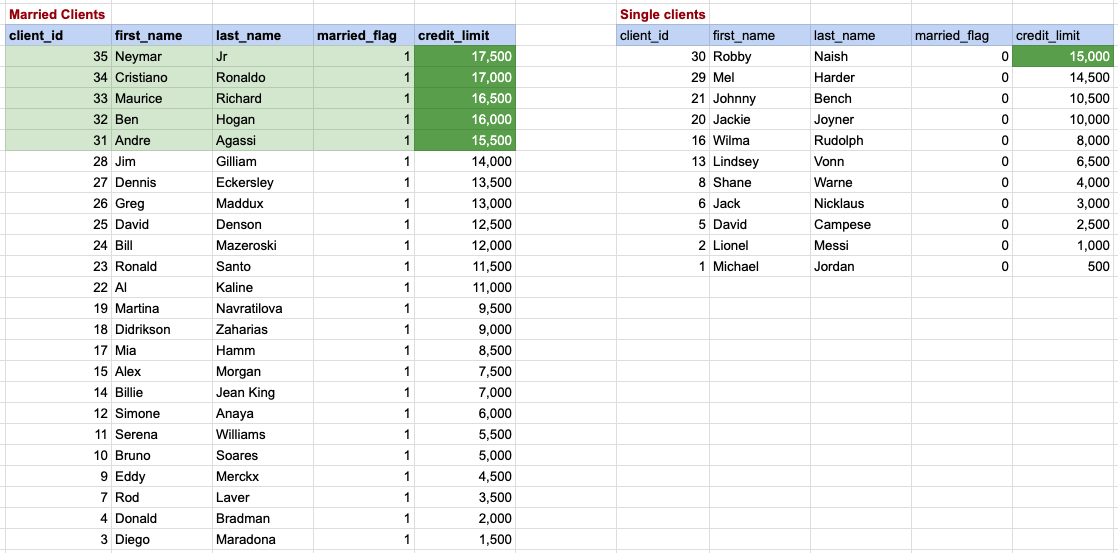
In this context, we are focused on identifying married couples whose credit limit is higher than the highest credit limit among bachelors. The bachelors and their respective credit limits are displayed on the right side, arranged in descending order with the top credit limit being 15,000. Therefore, for married clients to have a higher credit rating than all bachelors, they must exceed this top credit limit. Rows with a green background on the left represent the data of married couples that fulfill our criteria.
SQL ANY Clause
SELECT * FROM org_client WHERE birth_year = ANY (SELECT birth_year FROM org_client WHERE gender = 'M' AND married_flag = 0) AND gender = 'F' AND married_flag = 0;SQL ANY Clause data mapping

In this case, our goal is to find single female clients who share the same birth year as any of the single male clients. The data for single females, along with their birth years, is displayed on the left, while the information for single males is listed on the right. Single female clients whose data is highlighted with a green background are those whose birth year matches with that of a single male from the right side.
Comments Not Found