
MySQL
RIGHT JOIN
In MySQL, the RIGHT JOIN is used to return all records from the right (or second) table and the matching records from the left (or first) table. If there is no match, NULL values are returned for columns from the left table. This join type is useful when you want to retrieve all the data from the right table, even if some rows do not have corresponding data in the left table.
Here’s a detailed guide on how to use the RIGHT JOIN in MySQL, with examples for new students:
Basic Syntax of
RIGHT JOIN:- The
RIGHT JOINreturns all rows from the right table and the matching rows from the left table. If there is no match,NULLis returned for columns from the left table. - Syntax:
SELECT e.first_name, e.last_name, d.department_name FROM employees e RIGHT JOIN departments d ON e.department_id = d.department_id;- This query retrieves all department names from the
departmentstable, along with the first name and last name of employees who belong to those departments. If a department has no employees,NULLwill be returned for the employee columns.
- The
Using
RIGHT JOINwithWHEREClause:- You can filter the results of a
RIGHT JOINusing aWHEREclause. - Example:
SELECT e.first_name, e.last_name, d.department_name FROM employees e RIGHT JOIN departments d ON e.department_id = d.department_id WHERE d.department_name = 'Sales';- This query returns all employees in the Sales department and the department name, including departments with no employees.
- You can filter the results of a
Handling
NULLValues withRIGHT JOIN:- Since
RIGHT JOINincludes rows from the right table even if there is no match in the left table, you can useIS NULLto identify rows where there is no matching record in the left table. - Example:
SELECT d.department_name, e.first_name, e.last_name FROM employees e RIGHT JOIN departments d ON e.department_id = d.department_id WHERE e.employee_id IS NULL;- This query retrieves departments that do not have any employees.
- Since
Using
RIGHT JOINwith Multiple Tables:- You can perform
RIGHT JOINwith more than two tables to retrieve data from multiple related tables. - Example:
SELECT e.first_name, e.last_name, d.department_name, b.branch_name FROM employees e RIGHT JOIN departments d ON e.department_id = d.department_id RIGHT JOIN branches b ON d.branch_id = b.branch_id;- This query retrieves employees, department names, and branch names. It returns all branches, even if there are no matching departments or employees.
- You can perform
Using
RIGHT JOINwith Aggregate Functions:- You can combine
RIGHT JOINwith aggregate functions likeCOUNT(),SUM(), andAVG()to analyze data across related tables. - Example:
SELECT d.department_name, COUNT(e.employee_id) AS employee_count FROM employees e RIGHT JOIN departments d ON e.department_id = d.department_id GROUP BY d.department_name;- This query returns all departments and the number of employees in each. Departments with no employees will still be listed with a count of 0.
- You can combine
Combining
RIGHT JOINwithORDER BY:- You can use
RIGHT JOINwithORDER BYto sort the results based on columns from either the left or right table. - Example:
SELECT e.first_name, e.last_name, d.department_name FROM employees e RIGHT JOIN departments d ON e.department_id = d.department_id ORDER BY d.department_name ASC;- This query returns all departments and employees, sorted by department name in ascending order.
- You can use
Performance Considerations:
- Using
RIGHT JOINon large datasets can impact query performance. Indexing the columns used in theONclause can improve performance. - Example:
SELECT e.first_name, e.last_name, d.department_name FROM employees e RIGHT JOIN departments d ON e.department_id = d.department_id WHERE e.salary > 60000;- Indexing
department_idin both tables can make this query run more efficiently.
- Using
Combining
RIGHT JOINwith Other Joins:- You can combine
RIGHT JOINwith other types of joins likeLEFT JOINandINNER JOINto retrieve complex datasets from multiple tables. - Example:
SELECT e.first_name, e.last_name, d.department_name, b.branch_name FROM employees e RIGHT JOIN departments d ON e.department_id = d.department_id LEFT JOIN branches b ON d.branch_id = b.branch_id;- This query retrieves all departments and branches, and employees if they exist, ensuring that all departments and branches are included in the result.
- You can combine
The RIGHT JOIN is useful when you need to retrieve all records from one table (the right table) even if there are no matching records in the related table (the left table). This makes it a great tool when working with datasets where the right table must be fully included in the results.
To gain complete access, login with gmail or outlook, no need of signup, click here

Test code
Provide details for all products, including their product types. Include product types that do not have any assigned products. Achieve this by using a RIGHT JOIN in your SQL query, instead of the typical LEFT JOIN.
SELECT
    prd_product.product_id,
    prd_product.product_code,
    prd_product.product_name,
    prd_product.selling_price,
    prd_product.purchase_price,
    prd_product_type.product_type_id,
    prd_product_type.product_type
FROM prd_product
RIGHT OUTER JOIN prd_product_type ON prd_product_type.product_type_id = prd_product.product_type_id;EXAMPLE 1 - SQL RIGHT JOIN
Here is a clear example of a RIGHT JOIN. Retrieve information of all products along with their respective product type, including product types that have not been associated with any products.
EXAMPLE 1 - Tansy Academy Data Model
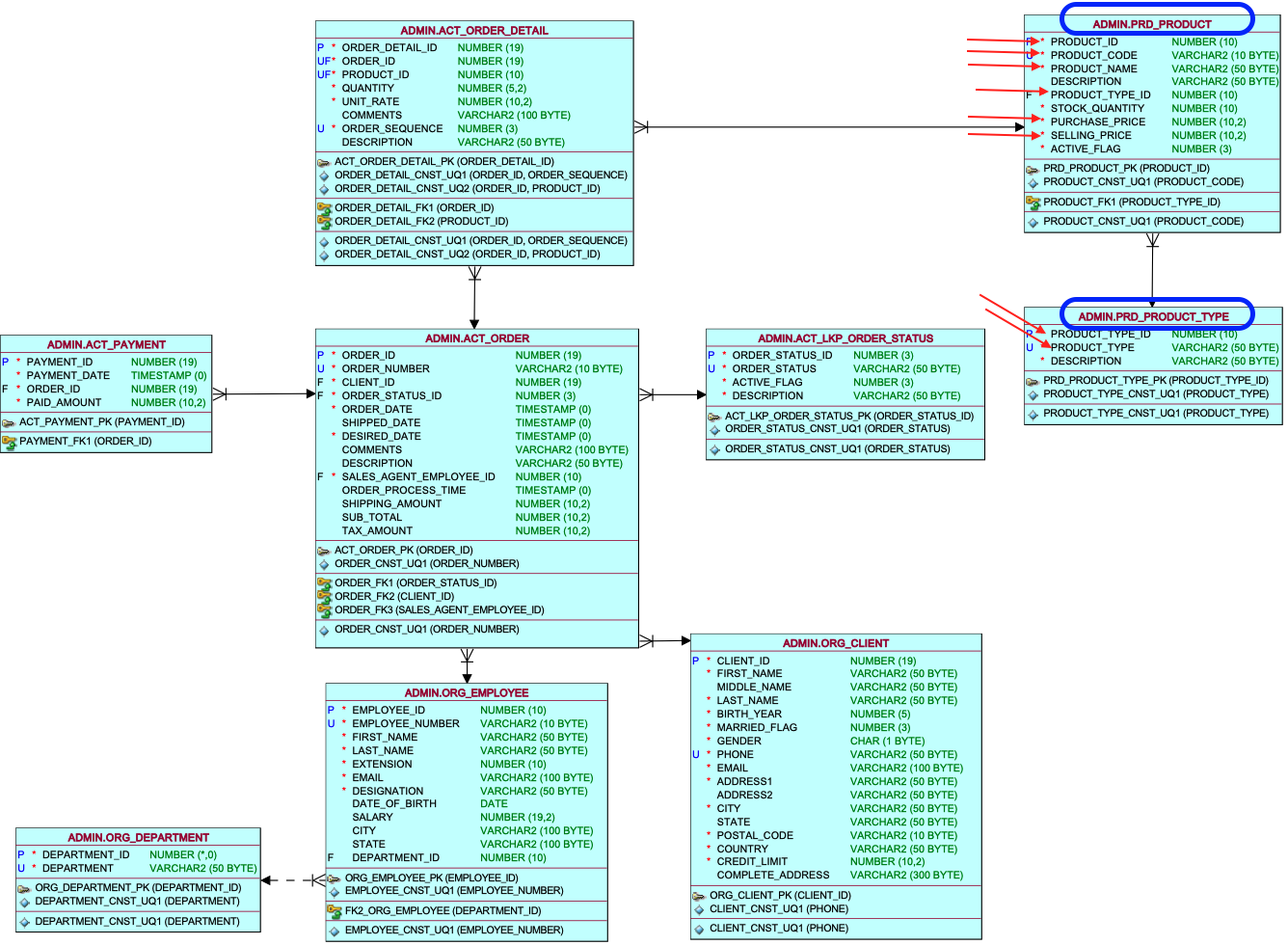
In this task, you will create a query involving two tables, named Products and ProductType, marked are the columns necessary for the query.
EXAMPLE 1 - RIGHT JOIN query
To achieve this, you need to execute a RIGHT JOIN between the product table and the product type detail table, utilizing the primary key and foreign key column, wherein the product type ID column serves as the joining column. In this scenario, the product table functions as the left table, and the product type detail table is considered the right table. The left table, which contains the essential primary business information, focuses on the product list as the primary requirement. At a secondary level, we seek prodcut type name, so we treat the product type as the secondary table, positioned on the right side of the join
SELECT prd_product.product_id, prd_product.product_code, prd_product.product_name, prd_product.selling_price, prd_product.purchase_price, prd_product_type.product_type_id, prd_product_type.product_type FROM prd_product RIGHT OUTER JOIN prd_product_type ON prd_product_type.product_type_id = prd_product.product_type_id ORDER BY prd_product.product_id;EXAMPLE 1 - Query Data Mapping
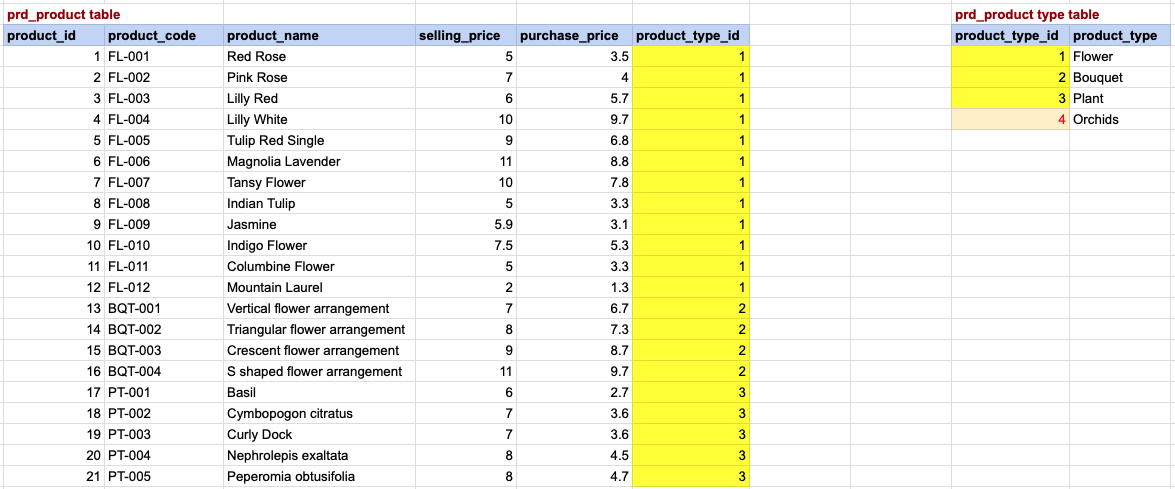
In this visual representation, a yellow background denotes a correspondence between the primary key and foreign key. Meanwhile, a light yellow background with red font on the right side signifies products lacking a corresponding row in the product type table. These product typess will be included in the final result, but with NULL values for product details. It's important to recognize that a RIGHT JOIN incorporates all rows from the right table, which, in this case, is the product type table.
EXAMPLE 1 - Final OUTput
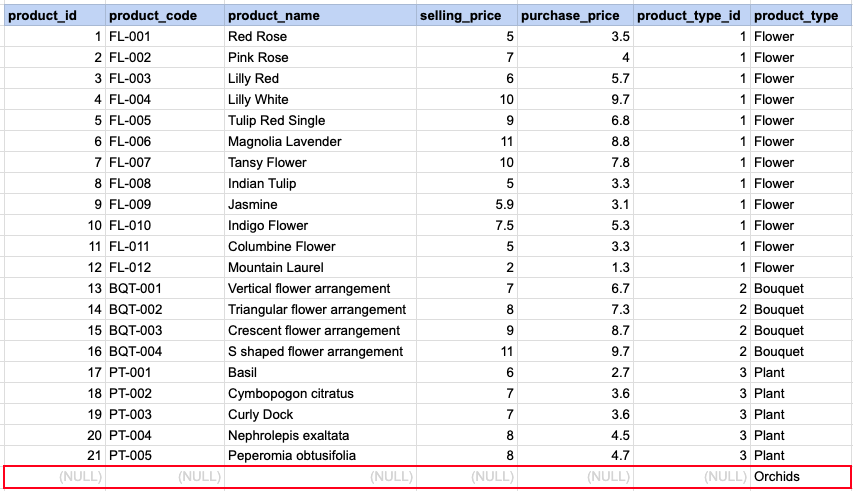
Please note that for rows in the left table that do not find a corresponding match in the right table, the values are marked as null.
Comments Not Found