
Oracle
Third Normal Form
Third Normal Form (3NF) is a crucial step in database normalization, designed to reduce redundancy and ensure that data dependencies are logical and consistent. A table is in 3NF if it is already in Second Normal Form (2NF) and if all the columns are dependent only on the primary key. In other words, a table is in 3NF if every non-key attribute is non-transitively dependent on the primary key, which means there are no transitive dependencies.
Here’s a step-by-step guide to understanding 3NF:
Ensure the Table is in 1NF and 2NF
- First Normal Form (1NF): All columns contain atomic values, and each column contains only a single value.
- Second Normal Form (2NF): The table is in 1NF and all non-key attributes are fully functionally dependent on the entire primary key.
Eliminate Transitive Dependencies
- Identify Transitive Dependencies: A transitive dependency occurs when a non-key attribute depends on another non-key attribute.
- Example: Consider a table
Bookswith columnsBookID,Title,AuthorID, andAuthorName. Here,AuthorNamedepends onAuthorID, which in turn depends onBookID. This creates a transitive dependency.
Decompose the Table
- Create New Tables: To eliminate transitive dependencies, decompose the original table into multiple tables.
- Example:
- Original Table:
Books(BookID, Title, AuthorID, AuthorName) - Decomposed Tables:
Books(BookID, Title, AuthorID)Authors(AuthorID, AuthorName)
- Original Table:
Maintain Referential Integrity
- Set Foreign Key Relationships: Ensure that foreign keys correctly reference primary keys in related tables.
- Example: In the
Bookstable,AuthorIDshould be a foreign key that referencesAuthorIDin theAuthorstable.
SQL Code Example
Here’s how you might normalize a table to 3NF:
-- Original Table with transitive dependency
CREATE TABLE Books (
    BookID INT PRIMARY KEY,
    Title VARCHAR(100),
    AuthorID INT,
    AuthorName VARCHAR(100)
);

-- Decomposed Tables to achieve 3NF
CREATE TABLE Books (
    BookID INT PRIMARY KEY,
    Title VARCHAR(100),
    AuthorID INT,
    FOREIGN KEY (AuthorID) REFERENCES Authors(AuthorID)
);

CREATE TABLE Authors (
    AuthorID INT PRIMARY KEY,
    AuthorName VARCHAR(100)
);
This decomposition ensures that Books and Authors tables each focus on a single subject, avoiding redundancy and making the database more efficient and easier to maintain.
Third Normal Form (3NF)
Third Normal Form (3NF) is a crucial concept in database normalization that ensures data is structured in a way that reduces redundancy and avoids undesirable dependencies. To be in 3NF, a database table must first satisfy the requirements of the Second Normal Form (2NF), and then go a step further to eliminate transitive dependencies among non-key attributes. Let's dive into the details of 3NF with a clear example.
Understanding 3NF
For a table to be in 3NF:
- It must already be in 2NF. This means that the table is in 1NF (all attributes contain only atomic values and the table contains no repeating groups), and all non-key attributes are fully functionally dependent on the primary key (i.e., no partial dependencies for composite primary keys).
- It must have no transitive dependencies. A transitive dependency occurs when a non-key attribute depends on another non-key attribute. To meet the 3NF requirements, every non-key attribute must directly depend on the primary key.
Why 3NF?
3NF is designed to improve database efficiency and integrity by:
- Reducing redundancy:Ensuring that all information is stored only once, which makes the database easier to maintain.
- Preventing update anomalies:Eliminating transitive dependencies helps prevent inconsistencies that can arise when data is updated in one place but not another.
Suppose we have a table calledEmployee_Departmentwith the following attributes:
- Employee_ID (Primary Key)
- Employee_Name
- Department_ID
- Department_Name
- Manager_ID
To achieve 3NF, we would decompose this table into two separate tables:
Table 1:Employee_Details:
- Employee_ID (Primary Key)
- Employee_Name
- Department_ID (Foreign Key)
Table 2:Department_Details:
- Department_ID (Primary Key)
- Department_Name
- Manager_ID (Foreign Key)
By doing this, we eliminate the transitive dependency betweenDepartment_NameandManager_ID, ensuring that each table represents a single entity and all attributes are functionally dependent on the primary key.
THIRD NORMAL FORM EXAMPLE
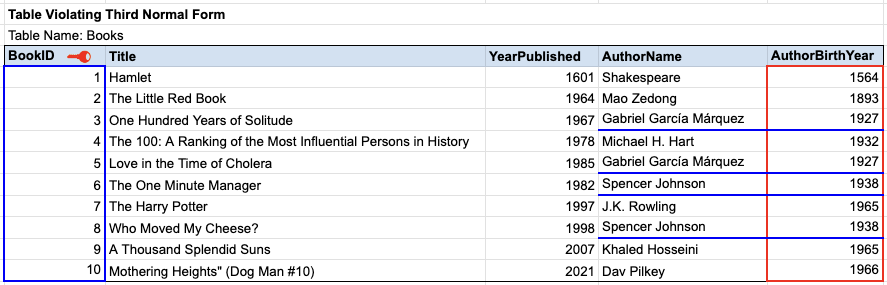
- 3NF Violation: The original books inventory table violates Third Normal Form (3NF) due to a transitive dependency.
- Transitive Dependency: The
author birth yearattribute does not depend functionally on the primary key (book id), but rather on another non-primary key attribute (author). - Solution for 3NF Compliance: To resolve this issue, transfer the
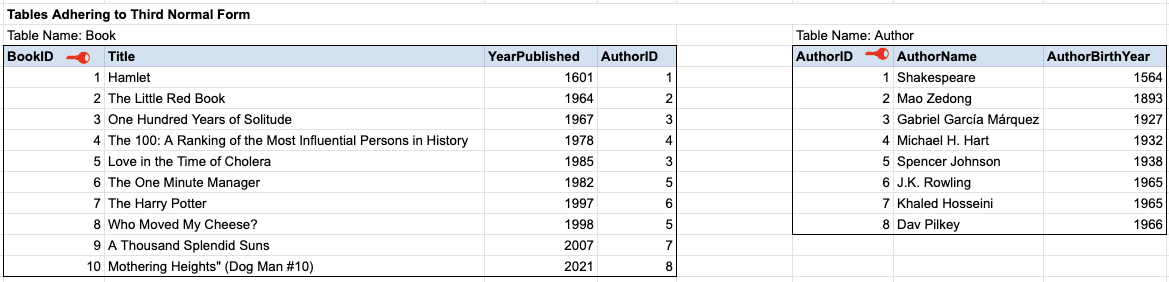
author nameandauthor birth yearfrom the books table to a separate dedicatedAuthorstable.
Comments Not Found