
Oracle
CAST
In Oracle, the CAST function is used to convert one data type into another. This is particularly useful when you need to perform operations on different data types or when you want to ensure that data conforms to a specific type for consistency. For example, you might want to convert a string to a date or a number to a string. The CAST function helps maintain data integrity and facilitates better data manipulation in your queries.
Key Points about CAST
Basic Syntax:
- The syntax for the
CASTfunction is:CAST(expression AS target_data_type)
- The syntax for the
Common Use Cases:
- Converting a string to a date:
SELECT CAST('2024-01-01' AS DATE) AS converted_date FROM dual; - Converting a number to a string:
SELECT CAST(12345 AS VARCHAR2(10)) AS converted_string FROM dual;
- Converting a string to a date:
Example with Database Tables:
- Suppose you have a table
bookswith a columnpublish_dateof typeVARCHAR2. To convert it to aDATE, you can use:SELECT CAST(publish_date AS DATE) AS actual_publish_date FROM books;
- Suppose you have a table
Nested
CASTExample:- You can also use
CASTwithin another function:SELECT CAST(AVG(CAST(price AS NUMBER)) AS NUMBER(10, 2)) AS average_price FROM books;
- You can also use
Best Practices:
- Ensure that the conversion makes sense; invalid conversions can lead to errors.
- Always specify the target data type clearly.
- Use
CASTin conjunction with error handling to avoid runtime exceptions. - Document the purpose of each conversion in your queries for better readability.
By following these guidelines and examples, beginners can effectively use the CAST function to manipulate and query data in Oracle databases.
To gain complete access, login with gmail or outlook, no need of signup. click here
TEST CODE
In this instance, the CAST function is applied to the order date, facilitating the conversion of datetime data type into the date format.
SELECT order_id, order_number, CAST(order_date AS DATE) AS order_date
FROM act_order;In this case, the CAST function is used to convert a numeric data type with decimals into an integer data type, eliminating any decimal points.
SELECT employee_id, employee_number, CAST(salary AS INTEGER) AS salary
FROM org_employee;Syntax of CAST
CAST(expression AS target_type)- expressionis the value you wish to convert.
- target_typeis the data type you want the result to be.
Examples of CAST
Converting a price to an integer:
SELECT CAST(price AS INT) FROM products;Formatting a date as a string:
SELECT CAST(order_date AS VARCHAR(10)) FROM orders;TheCASTfunction is part of the ANSI SQL standard and is supported by various SQL databases like MySQL, PostgreSQL, SQL Server, and SQLite, ensuring consistency in its use and behavior across these systems.
Limitations of the CAST Function in SQL
- Data Loss:Casting from a higher precision or larger capacity data type to a lower one can result in data loss or truncation, such as from
FLOATtoINT. - Performance:The
CASTfunction can increase computational overhead and affect query performance, especially with large datasets. - Data Type Compatibility:Not all data type conversions are supported, and incompatible conversions will result in errors.
- Syntax and Support:Different SQL systems may have varying levels of support for
CAST, potentially leading to inconsistencies. - Implicit Conversion Risks:Implicit conversions without
CASTcan lead to unexpected results if the rules for conversion are not well understood. - Locale and Format:Locale settings can affect the behavior of
CASTwith locale-sensitive data types like dates and times. - Storage Format:Data stored in non-standard formats may require additional manipulation beyond
CAST. - Precision and Scale:Consideration of precision and scale is necessary when casting to decimal types to avoid errors.
- SQL Injection:Dynamic SQL using
CASTcan be vulnerable to SQL injection if user input is not properly sanitized. - Default Values:Unlike
COALESCEorISNULL,CASTdoes not handle NULLs or provide a default value if conversion fails.
CAST EXAMPLE1
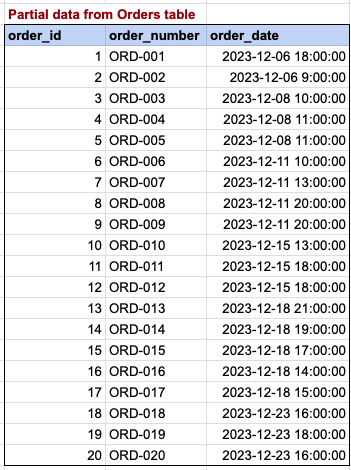
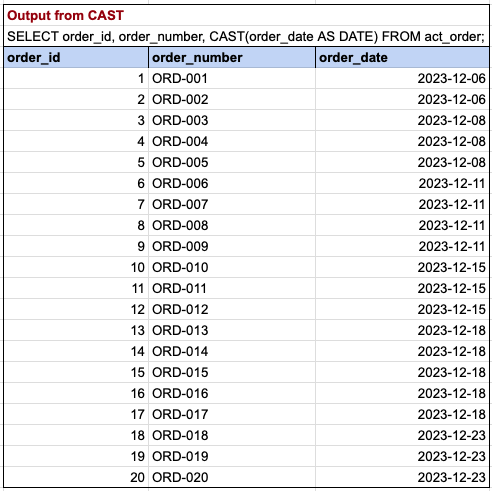
In this instance, the CAST function is applied to the order date, facilitating the conversion of datetime data type into the date format.
CAST EXAMPLE2
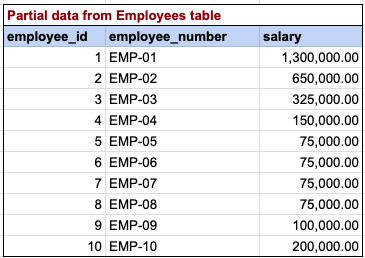
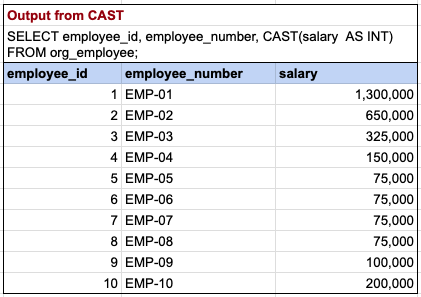
In this case, the CAST function is used to convert numeric data type with decimals into an integer data type, eliminating any decimal points.
Comments Not Found