
Oracle
Surrogate Key
A surrogate key is an artificial or synthetic key used to uniquely identify a record in a database table. Unlike natural keys, which are derived from the data itself (such as Social Security Numbers or email addresses), surrogate keys have no intrinsic meaning outside the context of the database. They are typically simple numeric values that can be used to ensure uniqueness without relying on natural data, which can be variable or change over time.
Here’s a basic overview of surrogate keys:
Definition and Purpose
- A surrogate key is a unique identifier created for the sole purpose of identifying a record in a database.
- It is usually an auto-incremented integer or a generated value that has no business meaning.
Characteristics
- Uniqueness: Each record in the table is uniquely identified by the surrogate key.
- Non-changing: Unlike natural keys, surrogate keys are less likely to change, which helps maintain data integrity.
Usage in SQL
- Surrogate keys are often used in primary key columns of tables.
- They simplify relationships between tables by providing a straightforward way to refer to records.
Example
Suppose we have a table calledauthorswhere we want to use a surrogate key:CREATE TABLE authors ( author_id NUMBER GENERATED BY DEFAULT AS IDENTITY PRIMARY KEY, name VARCHAR2(100), birth_date DATE );In this example:
author_idis the surrogate key. It’s an auto-incremented integer that uniquely identifies each author.nameandbirth_dateare natural attributes related to the author but not used as keys.
Benefits
- Simplifies Joins: Using surrogate keys in relationships can make joins simpler and more efficient.
- Stable References: Surrogate keys are stable identifiers, unlike natural keys that might change.
Considerations
- Extra Storage: Surrogate keys add an extra column to tables, which may increase storage requirements.
- Meaninglessness: They don’t convey any meaningful information about the record itself.
Using surrogate keys helps in creating a more reliable and manageable database schema, particularly when dealing with complex data relationships.
Definition and Characteristics
Synthetic Origin: Surrogate keys are artificially generated, meaning they are not derived from the application data. They are usually numeric and often implemented as an auto-incrementing number or a globally unique identifier (GUID).
Uniqueness: Like all primary keys, a surrogate key uniquely identifies each row in a table. No two rows can have the same surrogate key value.
Stability: Once assigned, the value of a surrogate key does not change. This stability is crucial for maintaining referential integrity across tables.
Non-significance: Surrogate keys have no intrinsic meaning. They do not carry information about the row's data, unlike natural keys, which are derived from application data and might convey meaning.
Advantages
- Simplicity: Using an auto-incrementing number as a surrogate key simplifies the creation and management of keys. It eliminates the need to determine which natural data attributes can serve as a unique identifier.
- Performance: Surrogate keys can improve database performance, especially in joins, indexing, and query speed, because of their simplicity and uniformity.
- Flexibility: They allow for changes in business rules without affecting the primary key. For instance, if the natural key changes (e.g., a product code is updated), it doesn't require modifying the primary key in the database.
- Referential Integrity: Surrogate keys aid in maintaining referential integrity, as they are stable and unaffected by changes in business data.
Use Cases
- Dimensional Modeling: In data warehousing and dimensional modeling, surrogate keys are extensively used to uniquely identify dimension members, making it easier to track historical changes in dimension attributes.
- Complex Natural Keys: When natural keys are complex (composed of multiple columns or prone to change), surrogate keys offer a simplified and stable alternative.
- Support for ORM: Object-Relational Mapping (ORM) tools often work better with surrogate keys, as they can automatically generate and manage these keys, simplifying the development process.
Considerations
- Overhead: Introducing an additional column for the surrogate key adds some overhead to the database schema. However, the benefits often outweigh this drawback.
- Misuse: Surrogate keys should not be used as a substitute for understanding and modeling real-world relationships. They are a technical solution to a technical problem, not a replacement for good database design.
Conclusion
Surrogate keys are an essential tool in database design, offering a simple, stable, and efficient means of uniquely identifying rows in a table. They are particularly useful in scenarios where natural keys are complex, subject to change, or unsuitable for some reason. While surrogate keys add a layer of abstraction over natural data, they facilitate better performance, flexibility, and integrity in database management and design.
SURROGATE KEY DATA MODEL
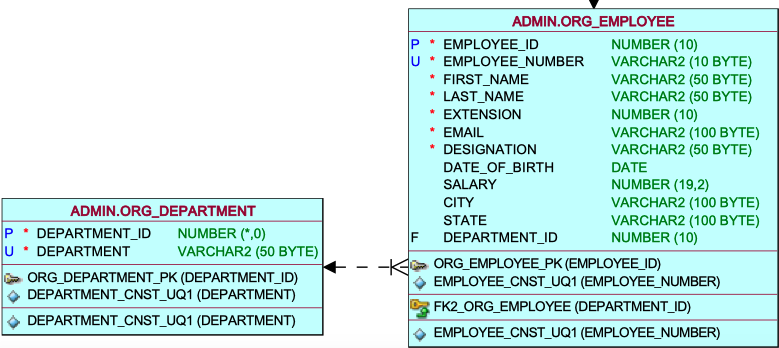
- Designated Surrogate Keys: The
department IDfrom the department table andemployee IDfrom the employee table are designated as surrogate keys. - No Inherent Business Meaning: Their primary function is to serve as unique primary keys without carrying intrinsic business significance.
- Foreign Key References: Surrogate keys are employed as primary keys and subsequently referenced in related tables as foreign keys.
- Internal System Values: In practical business scenarios, referencing an employee ID like
"32"is strictly an internal technical identifier for the database system.
SURROGATE KEY DATA

- Employee & Department Association: An employee with identifier
EMP-01is linked todepartment ID = 2. - Relational Lookup: Referencing this value in the Department table aligns with the Executive Department.
- Auto-Incrementing Key: The
department IDin the department table functions as an auto-incrementing surrogate primary key.
Comments Not Found