
Oracle
SQL Execution Order
Understanding the SQL execution order is crucial for effectively writing and optimizing queries in Oracle. The execution order refers to the sequence in which the different clauses of an SQL statement are processed by the database engine. While SQL statements may be written in a specific order, the database executes them in a predetermined sequence. Knowing this order helps you predict the outcome of complex queries and ensures efficient query performance.
Here’s the general execution order for SQL statements:
FROM Clause
- This clause identifies the tables from which to retrieve data.
- Joins are performed at this stage.
WHERE Clause
- Filters rows based on specified conditions.
- Only rows meeting the criteria from the FROM clause are considered.
GROUP BY Clause
- Groups the filtered rows based on one or more columns.
- Aggregate functions (like COUNT, SUM) are typically used here.
HAVING Clause
- Further filters groups created by the GROUP BY clause.
- Allows for conditions on aggregated data.
SELECT Clause
- Specifies the columns to be returned in the result set.
- Also allows for expressions and calculated fields.
ORDER BY Clause
- Sorts the result set based on one or more columns.
- This is the final step before the data is returned.
Example SQL Query
SELECT author_id, COUNT(book_id) AS book_count
FROM books
WHERE published_year > 2000
GROUP BY author_id
HAVING COUNT(book_id) > 5
ORDER BY book_count DESC;
Best Practices
Be Aware of Execution Order
- Understanding the execution order helps in writing efficient queries.
- Helps in troubleshooting issues related to filtering and grouping.
Use WHERE Before GROUP BY
- Filter rows before grouping to reduce the amount of data processed.
- This improves performance.
Minimize Data Retrieved
- Only select necessary columns to optimize performance.
- Reduces the amount of data transferred and processed.
Utilize Indexes
- Indexes can significantly speed up the retrieval of data.
- Ensure to use appropriate indexes on columns frequently used in WHERE clauses.
By adhering to these best practices, you can enhance both the efficiency and effectiveness of your SQL queries in Oracle.
SQL Query Order of Execution
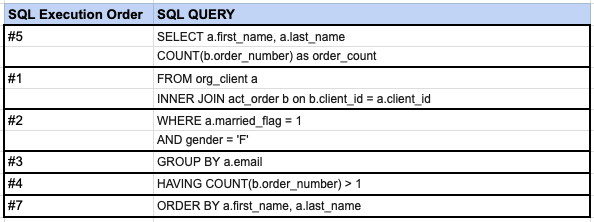
Below is an illustration depicting the internal processing sequence of different clauses in a SQL statement by the SQL engine. It's important to note that in this example, the DISTINCT and LIMIT clauses are not utilized.
SQL Execution Order
As illustrated in this image, the SQL engine initially executes the FROM clause and any INNER JOINs, followed by the other steps as depicted.
To gain complete access, login with gmail or outlook, no need of signup. click here
Comments Not Found