
Oracle
COALESCE
The COALESCE function in Oracle SQL is a powerful tool used to return the first non-null expression among its arguments. It is particularly useful for handling null values in your data, allowing you to provide default values or fallback options when necessary. This can be especially helpful in reporting and data presentation, ensuring that your results are more informative and user-friendly.
Key Points about COALESCE
Basic Usage
- The syntax for
COALESCEis:COALESCE(expr1, expr2, ..., expr_n) - It returns the first non-null expression in the list.
- The syntax for
Example with Books Table
- Consider a
bookstable with columnstitle,author_id, andsummary. If you want to retrieve the summary but return "No summary available" if it's null:SELECT title, COALESCE(summary, 'No summary available') AS summary FROM books;
- Consider a
Multiple Arguments
- You can provide multiple arguments to
COALESCE. It checks each in the order they are provided:SELECT title, COALESCE(summary, description, 'No description available') AS info FROM books;
- You can provide multiple arguments to
Use in JOINs
COALESCEcan also be useful in joins. For instance, if you want to joinauthorswithbooksand ensure you have a display name:SELECT b.title, COALESCE(a.name, 'Unknown Author') AS author_name FROM books b LEFT JOIN authors a ON b.author_id = a.id;
Best Practices
- Always check the data types of the columns being compared, as
COALESCEwill return the data type of the first non-null expression. - Use
COALESCEfor improved readability and maintainability of your SQL queries. - Avoid using too many arguments in
COALESCEas it can make your query complex.
- Always check the data types of the columns being compared, as
Conclusion
Using COALESCE effectively can enhance your SQL queries by managing null values gracefully, leading to clearer and more informative results. It's a valuable function to master for anyone working with Oracle databases.
To gain complete access, login with gmail or outlook, no need of signup. click here
TEST CODE
To replace descriptions with the string 'Not Provided' wherever the description is null, use the following query:
SELECT product_id, product_name, COALESCE(description, 'Not Provided') AS description
FROM prd_product
ORDER BY product_id;TheCOALESCEfunction in SQL returns the first non-null expression among its arguments. This function is useful for handling cases where data may be missing and a default value is needed.
Syntax of COALESCE
COALESCE(expression1, expression2, ..., expressionN)- The function evaluates the expressions in order.
- It returns the first non-null expression.
- If all expressions are null,
COALESCEreturns null.
Example Usage of COALESCE
Here's an SQL query example usingCOALESCE:
SELECT COALESCE(address, phone, email, 'Unknown') AS contact_info FROM customers;This example attempts to find the first non-null contact information for each customer and defaults to 'Unknown' if all are null.
COALESCE with LEFT JOIN
COALESCEcan be used withLEFT JOINto provide a default value when the joined table has no match:
SELECT customers.name, COALESCE(orders.order_number, 'No Orders') as order_info
FROM customers
LEFT JOIN orders ON customers.customer_id = orders.customer_id;
In this scenario, if a customer has no orders, 'No Orders' is returned instead of null.
COALESCE EXAMPLE
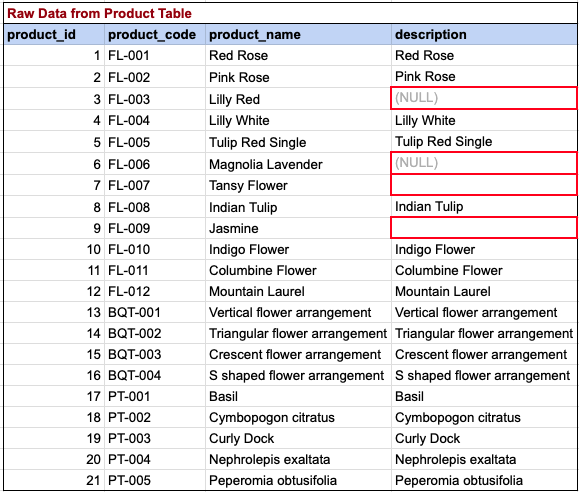
Here, we are attempting to substitute descriptions with the string 'Not provided' in cases where the description is null.
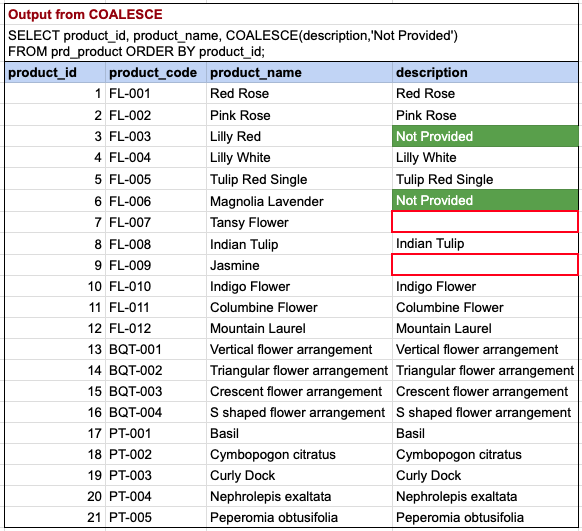
Please note that the query has successfully replaced null descriptions for product IDs 3 and 6 with the desired string 'Not Provided'. However, descriptions for product IDs 7 and 9 remain as empty strings. It's important to differentiate between an empty string and NULL. Our query was designed to replace NULL values, not empty strings.
Comments Not Found