
PostgreSQL
GROUP RANK
In PostgreSQL, the concept of "GROUP RANK" typically involves ranking groups of rows within a result set according to specific criteria. This is commonly achieved using window functions in conjunction with GROUP BY Window functions are useful for performing calculations across a set of table rows that are somehow related to the current row.
Here’s a step-by-step guide on how to use PostgreSQL to rank groups of rows:
- Understand the Context: Group ranking is often used to rank items within categories. For example, you might want to rank customers based on their total transaction amounts within each branch of a bank.
- Use of Window Functions: PostgreSQL provides window functions such as
ROW_NUMBER(),RANK(), andDENSE_RANK()to assign ranks to rows within partitions of a result set. - Example Query: Suppose you have a
transactionstable and you want to rank customers based on the total amount they have transacted, grouped by their branch.-- Example table structure: -- transactions (id, customer_id, branch_id, amount) SELECT customer_id, branch_id, SUM(amount) AS total_amount, RANK() OVER (PARTITION BY branch_id ORDER BY SUM(amount) DESC) AS rank FROM transactions GROUP BY customer_id, branch_id ORDER BY branch_id, rank; - Explanation:
PARTITION BY branch_iddivides the result set into partitions (one for each branch).ORDER BY SUM(amount) DESCorders the rows within each partition by the total transaction amount in descending order.RANK()assigns a rank to each row within its partition based on the specified order.
- Common Use Cases:
- Ranking employees by sales performance within each department.
- Ranking products by sales volume within each category.
By understanding and applying these concepts, you can effectively rank groups of data in PostgreSQL, which is valuable for generating reports and analyzing grouped datasets.
To gain complete access, login with gmail or outlook, no need of signup. click here

TEST CODE
In PostgreSQL, to utilize the RANK() function to assign rankings to employee salaries within specific departments, you can use the following query:
SELECT
  employee_number,
  department,
  salary,
  RANK() OVER (PARTITION BY department ORDER BY salary DESC) AS salary_rank
FROM
org_employee;SQL GROUP RANK
Utilize the RANK() function to assign rankings to employee salaries within specific departments.
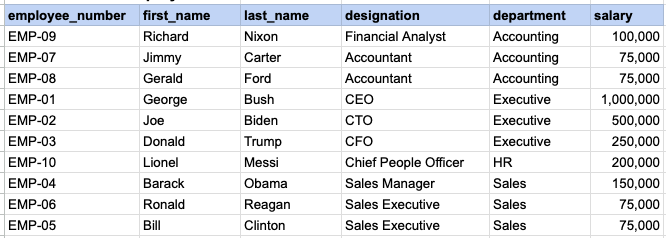
RAW EMPLOYEE DATA
QUERY DATA MAPPING
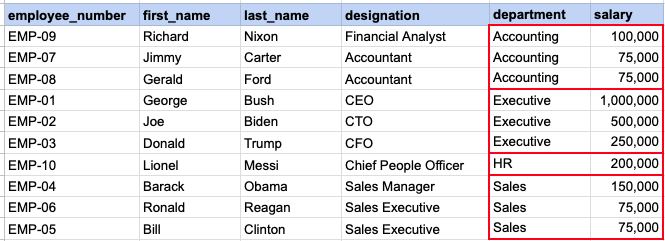
This image demonstrates that we need to rank each salary within a specified department. In PostgreSQL, we use PARTITION BY for this purpose.
QUERY OUT PUT
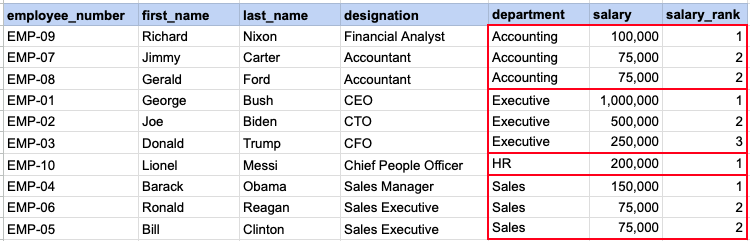
Here you can see ranking of each salary with in a given department.
Comments Not Found