
PostgreSQL
GROUP BY
In PostgreSQL, the GROUP BY clause is used in a SELECT query to arrange identical data into groups. It is commonly used with aggregate functions like COUNT(), SUM(), AVG(), MIN(), and MAX() to perform operations on a group of rows that share a particular column's value. This allows you to group rows based on one or more columns and perform operations on each group separately. For example, you can calculate the total balance of customers grouped by the type of account they hold in a banking database.
How to Use GROUP BY in PostgreSQL
- Basic Structure of
GROUP BY: TheGROUP BYclause is used after theWHEREclause and before theORDER BYclause (if any).SELECT column_name, aggregate_function(column_name) FROM table_name WHERE condition GROUP BY column_name; - Example of Grouping Data:Let's say you have a table called
transactionswith the following columns:transaction_id: The unique ID of each transactioncustomer_id: The ID of the customeramount: The amount of the transactiontransaction_date: The date when the transaction occurred
You can group the transactions by the
customer_idand calculate the total transaction amount for each customer.SELECT customer_id, SUM(amount) AS total_spent FROM transactions GROUP BY customer_id; - Grouping Multiple Columns: You can group by more than one column. For instance, to group transactions by both
customer_idand thetransaction_date, you can do the following:SELECT customer_id, transaction_date, SUM(amount) AS total_spent FROM transactions GROUP BY customer_id, transaction_date; - Using
HAVINGwithGROUP BY: TheHAVINGclause is used to filter groups based on a condition after theGROUP BYhas been applied. It is similar to theWHEREclause, but works on aggregated data.Example: Get the customers who have spent more than $500 in total.
SELECT customer_id, SUM(amount) AS total_spent FROM transactions GROUP BY customer_id HAVING SUM(amount) > 500; - Combining
GROUP BYwith Other Aggregates: In aGROUP BYquery, you can use multiple aggregate functions to get various statistics. For example, getting the count of transactions and the total amount spent by each customer:SELECT customer_id, COUNT(transaction_id) AS transaction_count, SUM(amount) AS total_spent FROM transactions GROUP BY customer_id;
This should give beginners a good start with understanding how GROUP BY works in PostgreSQL along with examples relevant to a banking scenario.
To gain complete access, login with gmail or outlook, no need of signup. click here

TEST CODE
In PostgreSQL, to calculate the total count of clients in each state, you can use the following query:
SELECT state, COUNT(client_id)
FROM org_client
GROUP BY state;In PostgreSQL, to determine the aggregate salary disbursement by each department, you can use the following query:
SELECT department, SUM(salary)
FROM org_employee
GROUP BY department;In PostgreSQL, to identify the year of birth of the youngest client from each state, you can use the following query:
SELECT state, MAX(birth_year)
FROM org_client
GROUP BY state;In PostgreSQL, to calculate the number of orders for each day, you can use the following query:
SELECT DATE(order_date) AS order_date,
COUNT(order_number) AS order_count
FROM act_order
GROUP BY DATE(order_date);In PostgreSQL, to tally the orders handled by each employee or sales agent, you can use the following query:
SELECT b.employee_number,
COUNT(a.order_number) AS order_count
FROM act_order a
INNER JOIN org_employee b ON b.employee_id = a.sales_agent_employee_id
GROUP BY b.employee_number;In PostgreSQL, to get the number of female clients in each city, you can use the following query:
SELECT city, COUNT(client_id) AS client_count
FROM org_client
WHERE gender = 'F'
GROUP BY city;Example 1:
In the following example, we will demonstrate the application of WHERE, GROUP BY, and HAVING clauses. It's important to note that the WHERE clause is used before GROUP BY, and the HAVING clause follows GROUP BY. Also, the HAVING clause cannot be used without preceding it with GROUP BY.
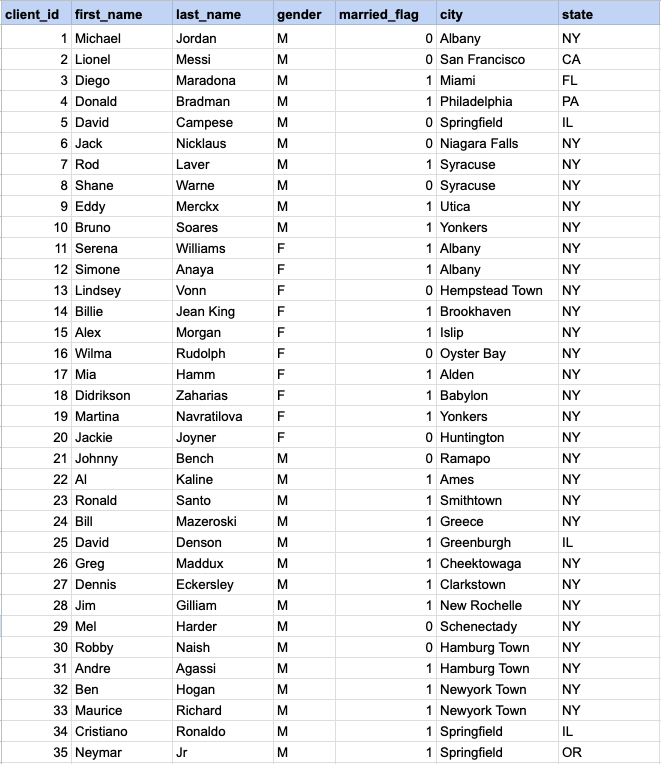
Example 1 - Raw data from client table
GROUP BY query
In this example, we will ascertain the number of married female clients in each city, and then identify cities that have more than one married female client.
SELECT city ,
count(client_id)
FROM org_client
WHERE gender= 'F'
AND married_flag = 1
GROUP BY city
HAVING count(client_id) > 1
Step 1, Apply WHERE conditions
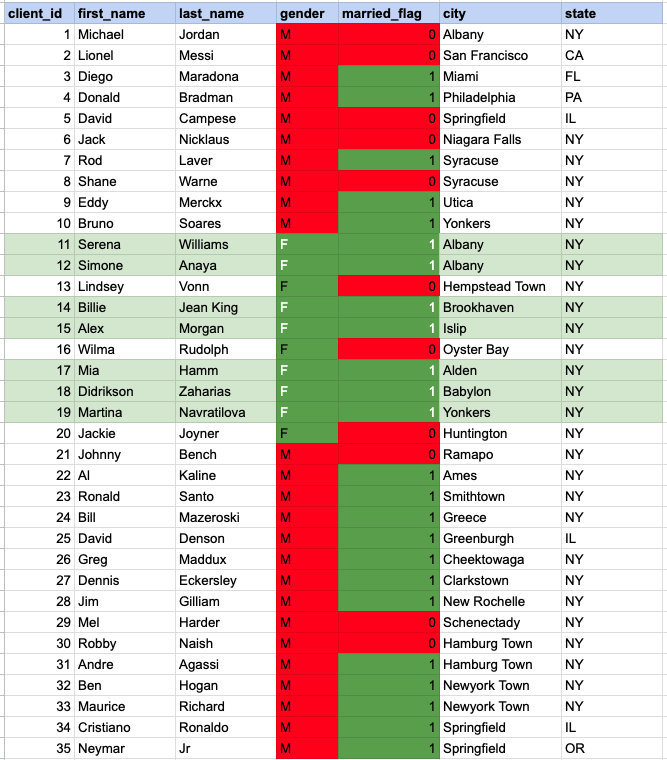
In the image above, the cells highlighted with a green background and white font represent those that satisfy both criteria of the WHERE condition (being married females).
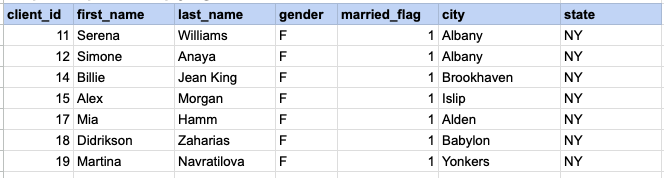
Step 1 output after applying WHERE condition
Step 2 - Apply GROUP BY
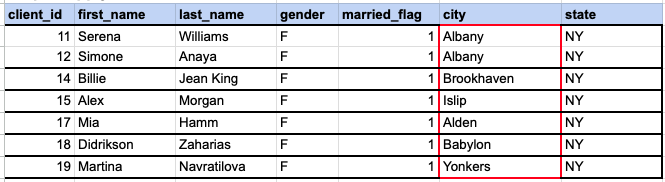
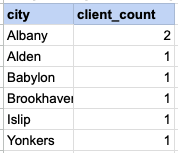
In the provided image, we need to group the data by the 'city' column. As observed, Albany is represented by 2 client rows, while the other cities each have only one row.
Step 2 output, after applying GROUP BY
Step 3 - Apply HAVING Clause
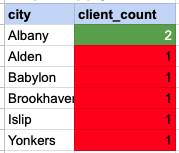
Using the HAVING clause essentially means filtering the grouped rows based on the condition specified in the HAVING clause. In this example, we are looking for groups with a client count greater than one. The cells highlighted in green with white font are those that meet the condition set by the HAVING clause.
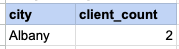
Final output of entire query
Comments Not Found