
PostgreSQL
EXISTS, ANY and ALL Clause
PostgreSQL's Data Query Language (DQL) is mainly focused on querying data. Three important clauses in DQL are EXISTS, ANY, and ALL, which are used to refine the results of your queries by filtering data based on certain conditions. These clauses are particularly useful when dealing with subqueries or when comparing values across multiple rows.
- EXIST Clause
The
EXISTSclause is used to check whether a subquery returns any rows. If the subquery returns at least one row, theEXISTSclause will evaluate toTRUE. This is commonly used in scenarios where the presence of related data in another table needs to be checked.- Example: Find all customers who have at least one account.
SELECT customer_id, customer_name FROM customers c WHERE EXISTS ( SELECT 1 FROM accounts a WHERE a.customer_id = c.customer_id ); - In this example, for each customer in the
customerstable, the query checks whether there is an associated row in theaccountstable with the samecustomer_id.
- Example: Find all customers who have at least one account.
- ANY Clause
The
ANYclause compares a value to any value in a set or result of a subquery. It returnsTRUEif the condition is met for at least one element in the set.- Example: Find all transactions that are larger than the smallest transaction made by customer ID 101.
SELECT transaction_id, amount FROM transactions WHERE amount > ANY ( SELECT amount FROM transactions WHERE customer_id = 101 ); - This query compares each transaction’s amount with the smallest amount in the subquery result for customer ID 101.
- Bullet points:
ANYchecks if a condition is satisfied by at least one value.- It can be used with comparison operators like
=,>,<, etc.
- Bullet points:
- Example: Find all transactions that are larger than the smallest transaction made by customer ID 101.
- ALL Clause
The
ALLclause compares a value to all values in a set or subquery result. It returnsTRUEonly if the condition holds true for every value in the set.- Example: Find all accounts with a balance greater than all accounts of customer ID 202.
SELECT account_id, balance FROM accounts WHERE balance > ALL ( SELECT balance FROM accounts WHERE customer_id = 202 ); - This query retrieves accounts whose balances are higher than the balance of every account held by customer ID 202.
- Bullet points:
ALLensures that a condition is true for every value in the set.- It is often used with comparison operators like
=,>,<, etc.
- Bullet points:
- Example: Find all accounts with a balance greater than all accounts of customer ID 202.
These clauses are powerful tools when querying complex datasets and ensuring you retrieve the exact data you need in your PostgreSQL database.
To gain complete access, login with gmail or outlook, no need of signup. click here

TEST CODE
In PostgreSQL, to select all customers who have placed an order, you can use the EXISTS operator with the following query:
SELECT *
FROM org_client
WHERE EXISTS (SELECT 1 FROM act_order WHERE org_client.client_id = act_order.client_id);In PostgreSQL, to identify married couples whose credit limit surpasses the credit limit of every bachelor, you can use the ALL operator with the following query:
SELECT *
FROM org_client
WHERE credit_limit > ALL (SELECT credit_limit FROM org_client WHERE married_flag = 0)
AND married_flag = 1;In PostgreSQL, to identify single female clients born in the same year as any single male clients, you can use the ANY operator with the following query:
SELECT *
FROM org_client
WHERE birth_year = ANY (SELECT birth_year FROM org_client WHERE gender = 'M' AND married_flag = 0)
AND gender = 'F'
AND married_flag = 0;SQL EXISTS Clause
SELECT * FROM org_client
WHERE EXISTS (SELECT 1 FROM act_order WHERE org_client.client_id = act_order.client_id);
SQL EXISTS Clause - data mapping
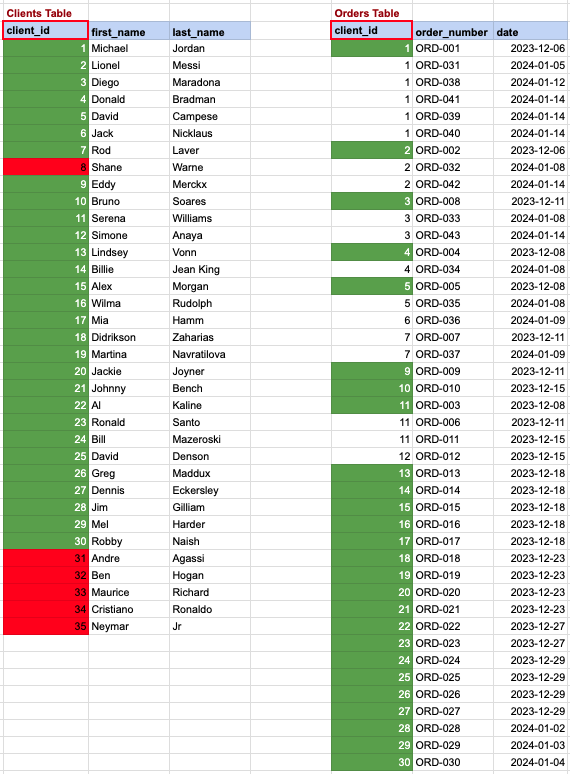
In this scenario, we aim to list clients who have made at least one order. Referring to the image, the clients from the 'clients' table, highlighted with a green background, meet our criteria, as they have placed one or more orders in the 'orders' table on the right. Conversely, clients marked with a red background are those who haven't placed any orders in the table on the right.
SQL ALL Clause
SELECT * FROM org_client
WHERE credit_limit > ALL (SELECT credit_limit FROM org_client WHERE married_flag = 0)
AND married_flag = 1;
SQL ALL Clause data mapping
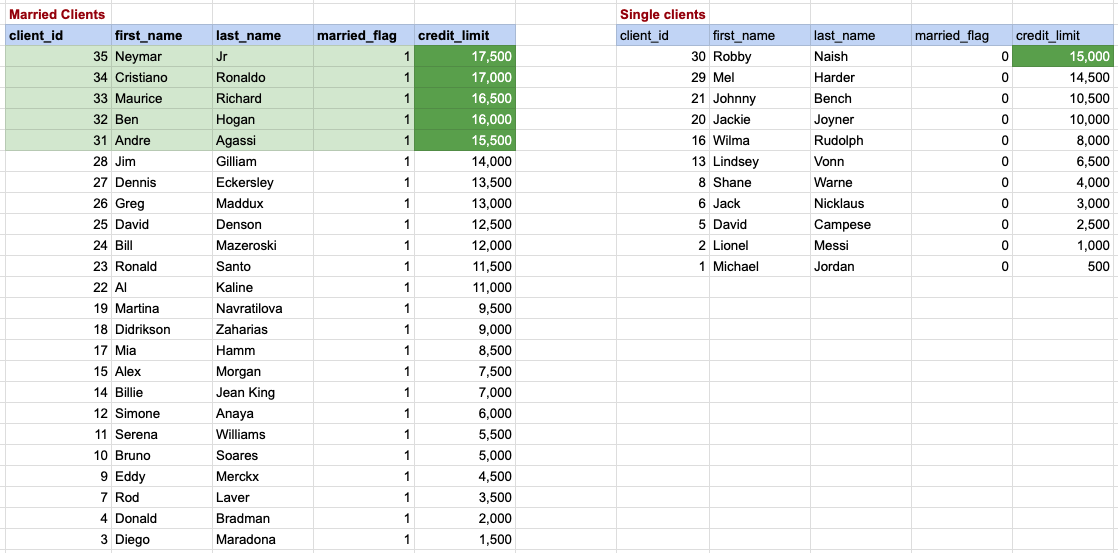
In this context, we are focused on identifying married couples whose credit limit is higher than the highest credit limit among bachelors. The bachelors and their respective credit limits are displayed on the right side, arranged in descending order with the top credit limit being 15,000. Therefore, for married clients to have a higher credit rating than all bachelors, they must exceed this top credit limit. Rows with a green background on the left represent the data of married couples that fulfill our criteria.
SQL ANY Clause
SELECT * FROM org_client
WHERE birth_year = ANY (SELECT birth_year FROM org_client WHERE gender = 'M' AND married_flag = 0)
AND gender = 'F'
AND married_flag = 0;
SQL ANY Clause data mapping

In this case, our goal is to find single female clients who share the same birth year as any of the single male clients. The data for single females, along with their birth years, is displayed on the left, while the information for single males is listed on the right. Single female clients whose data is highlighted with a green background are those whose birth year matches with that of a single male from the right side.
Comments Not Found